EXECUTIVE SUMMARY
There is no universal premium retail model.
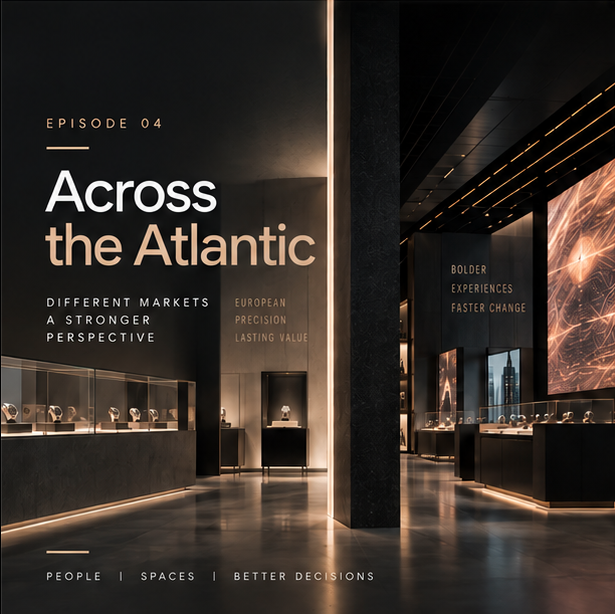
Europe and the United States demonstrate how geography, culture, infrastructure, technology and consumer behaviour can produce fundamentally different interpretations of physical retail—even when the same international brands operate in both markets.
European premium retail traditionally places considerable emphasis on materiality, craftsmanship, individual boutiques and controlled brand environments. In the United States, retail is shaped by greater distances, larger formats, department-store and store-in-store models, and a more proactive sales culture.
Technology introduces another contrast. Certain American markets—particularly technology-oriented regions—adopt digital signage, interactive environments and highly visible technology more aggressively. European luxury has traditionally integrated technology more discreetly, protecting a more restrained expression of premium.
At the same time, Europe retains a significant ecosystem of specialist material suppliers, manufacturers and implementation know-how serving global luxury retail. This capability becomes strategically relevant when premium environments require unusual materials, specialist fabrication and high levels of execution.
Neither model provides a universal answer. American retail demonstrates the value of operational complexity, active customer engagement and technology adoption. European luxury demonstrates the value of material knowledge, restraint, craftsmanship and long-established premium codes.
For international brands, the lesson is therefore not to export one retail formula globally. The stronger approach is to preserve brand identity while understanding how premium is interpreted, delivered and experienced in each market.
KEY TAKEAWAYS
- 01Premium is culturally specific.
- 02Europe and the US hold different competitive strengths.
- 03Technology should follow the market, not fashion.
- 04Global consistency does not require global uniformity.
TRANSCRIPT (FULL)
KEVIN
Welcome back to ENDORIENCE.
In this episode, we’re going international.
Gergő Nidermayer has just returned from a multi-city tour across the United States, where he attended several major retail conferences and visited a range of stores and showrooms.
Today we’re looking at what he observed on the ground.
What are American retailers doing differently? What can European brands learn from them? And, just as importantly, what does Europe do differently?
We’ll discuss trends, technology, materials and trade policy as we examine what is shaping retail on both sides of the Atlantic.
Gergő, thank you again for joining me.
GERGŐ
Hello, Kevin. Thank you for having me again.
KEVIN
You visited several retail conferences in the US. What themes or innovations did you repeatedly see?
GERGŐ
First, we need to recognise that the European and US markets are very different.
The obvious difference is scale. The US has larger distances, larger numbers and larger opportunities.
But the way people think about retail is also different.
In Europe, we often enjoy visiting stores, touching products and experiencing them physically. Distances between retail destinations are relatively short.
In the US, if you want to find a particular brand, product or specialist retailer, you may need to travel significantly further.
KEVIN
A lot of American premium shopping also happens in store-in-store environments or department stores rather than individual boutiques.
GERGŐ
Exactly.
In Paris, for example, you can find many brands operating individual boutiques.
In the US, store-in-store concepts are much more common.
Different brands may operate within the same wider retail environment.
They maintain elements of their own identity, but inevitably share some of the overall retail experience.
KEVIN
What other differences did you notice?
GERGŐ
From a European perspective, some American premium retail environments can appear more conservative in terms of design, material usage and certain current trends.
That doesn’t necessarily mean the original quality was lower.
But many specialist materials used in high-end and luxury environments come from Europe or elsewhere internationally.
If you think about certain stones, specialist woods or other premium materials, European suppliers remain extremely important.
There is also a strong ecosystem of European manufacturers with specific know-how in high-end retail implementation.
KEVIN
So there is a difference between design innovation, technology innovation and manufacturing capability.
GERGŐ
Exactly.
The United States is extremely strong in technology, IT and AI.
Traditional premium and luxury manufacturing is a different field.
Another difference is lifecycle.
In Europe or the Middle East, a premium retail environment may be significantly refreshed after three to five years, and often within seven years.
In the US, some comparable environments may remain substantially unchanged for longer.
KEVIN
That is interesting because Americans often think of the US as the innovation leader.
GERGŐ
And in technology it often is.
But traditional premium and luxury environments operate according to a different logic.
KEVIN
What else surprised you?
GERGŐ
The priorities within the spaces can also be different.
In European or Middle Eastern luxury retail, a great deal of attention goes directly into the sales floor, VIP areas and product presentation.
In the US, other operational areas can receive significant attention as well.
Even something as simple as customer bathrooms illustrates cultural and regulatory differences.
In many American retail formats, especially larger stores and automotive dealerships, they are considered a basic part of the customer environment.
KEVIN
Let’s move towards technology.
How are digital signage, interactive displays and data-driven POS systems being integrated differently?
GERGŐ
First, neither Europe nor the United States is one homogeneous market.
The West Coast and East Coast can be very different.
In California, for example, you can see screens, LED walls and digital content almost everywhere.
In places such as New Orleans or Charlotte, digital elements can be much more conservative and integrated into the architecture.
So even within the United States there are very different approaches.
KEVIN
Did you see anything that you think will move from the US to Europe?
GERGŐ
Design-wise, not necessarily.
In parts of the US, retailers often need to be brighter and more visible simply because there is so much competition for attention.
European high-end and luxury environments have traditionally been more restrained.
Digital signage has started entering luxury environments more visibly, but historically many established brands avoided it because their customers did not require it.
KEVIN
So American customers may associate more visible technology with premium?
GERGŐ
In some markets, yes.
But global brands can also moderate that.
They may use a lot of technology behind the scenes without necessarily making all of it visually dominant.
KEVIN
What about sustainability?
GERGŐ
Europe places significantly greater regulatory and strategic emphasis on sustainability.
That affects the materials we can use and the way we design and manufacture.
The United States has different priorities and regulations.
Fire resistance, accessibility, seismic requirements and other rules can vary considerably by state or region.
So anyone delivering internationally needs to understand exactly which materials and technical solutions are appropriate in each market.
KEVIN
What about tariffs and trade policy?
GERGŐ
The impact varies by segment.
At the very top of the luxury market, a customer buying an extremely expensive product may be relatively insensitive to a moderate price increase.
At lower premium levels—cars and other high-value products, for example—the impact can be much more significant.
Brands may delay expansion decisions while they wait for greater certainty.
There is also a question of manufacturing capability.
Even if tariffs encourage more local production, high-end retail requires specialist machinery, materials, people and know-how that cannot necessarily be recreated immediately.
KEVIN
What is one thing American retailers do particularly well?
GERGŐ
Complexity.
They are very good at operating complex retail environments where different brands and functions coexist.
And the sales process is different.
Sales staff are generally much more proactive.
The space itself often supports that more active sales approach.
In Europe, the traditional approach can be more restrained: customers enter, look around independently and ask for assistance when they need it.
In the US, interaction often begins immediately.
KEVIN
And what does Europe do particularly well?
GERGŐ
When it comes to high-end and luxury retail, Europe has a very deep understanding of what premium and luxury mean.
That is connected not only to tradition, but to how brands operate, how products are created and how the retail environment expresses those values.
KEVIN
Thank you, Gergő. It has been fascinating hearing an outside perspective on the US from someone working across both markets.
GERGŐ
Thank you, Kevin. I hope to see you soon.