EXECUTIVE SUMMARY
An attractive concept is not yet a responsible investment case. It becomes viable only when its essential promise survives customer behaviour, economics, site conditions, regulation, operations, delivery and whole-life performance without relying on invisible heroics.
This paper introduces a seven-case viability test for premium retail and hospitality concepts. It helps leaders identify contradictions early, distinguish feasibility from value and decide whether to proceed, adapt, pilot, pause or stop before commitment makes failure expensive.
KEY TAKEAWAYS
- 01Feasibility asks whether something can be delivered; viability asks whether it remains worth delivering.
- 02Customer, commercial, site, regulatory, operational, delivery and whole-life cases must support the same proposition.
- 03Real environmental and operating conditions should be tested before design preferences become commitments.
- 04Adapt, pilot, pause and stop are legitimate outcomes of responsible concept development.
How premium concepts earn the right to be implemented
A FAMILIAR SITUATION
The concept everyone wants to protect
The hero image has done its work. Leadership can see the future environment: the arrival, the material character, the service choreography, the moment customers will photograph. The concept has become emotionally real before it is operationally real.
Questions now arrive as threats to coherence. Can the team replenish the display during trading hours? Will the proposed material age consistently? Does the space work for customers who do not follow the expected journey? Can the service model survive an ordinary busy day? Each question is sent to a specialist to solve without changing the idea.
This is how an attractive concept becomes an expensive obligation. The organisation protects the image while site, cost, operation and delivery are asked to absorb its contradictions.
Feasible is not the same as viable
A buildability review asks whether an environment can be made. A cost plan estimates what it may cost. A programme tests whether activities fit a date. A code review tests compliance. Each is necessary. None answers whether the concept remains worth implementing when the full system becomes visible.
Viability asks a larger executive question: should we commit to this concept, in this place, through this operating and delivery model, at this level of risk - and what must be true before we do?
The distinction is important because almost anything can be made technically possible with enough money, time, bespoke engineering and exceptional effort. Responsible viability considers whether those resources are justified, repeatable and aligned with the value the concept is meant to create.
Appraisal frameworks such as the UK Green Book and Infrastructure Australia separate objectives, options, economics and delivery. RIBA places strategic definition and briefing before concept design. These are not retail concept models, but they expose the same weakness: a preferred expression should not acquire decision authority before purpose, constraints and evidence expectations are explicit. [S02-S04]
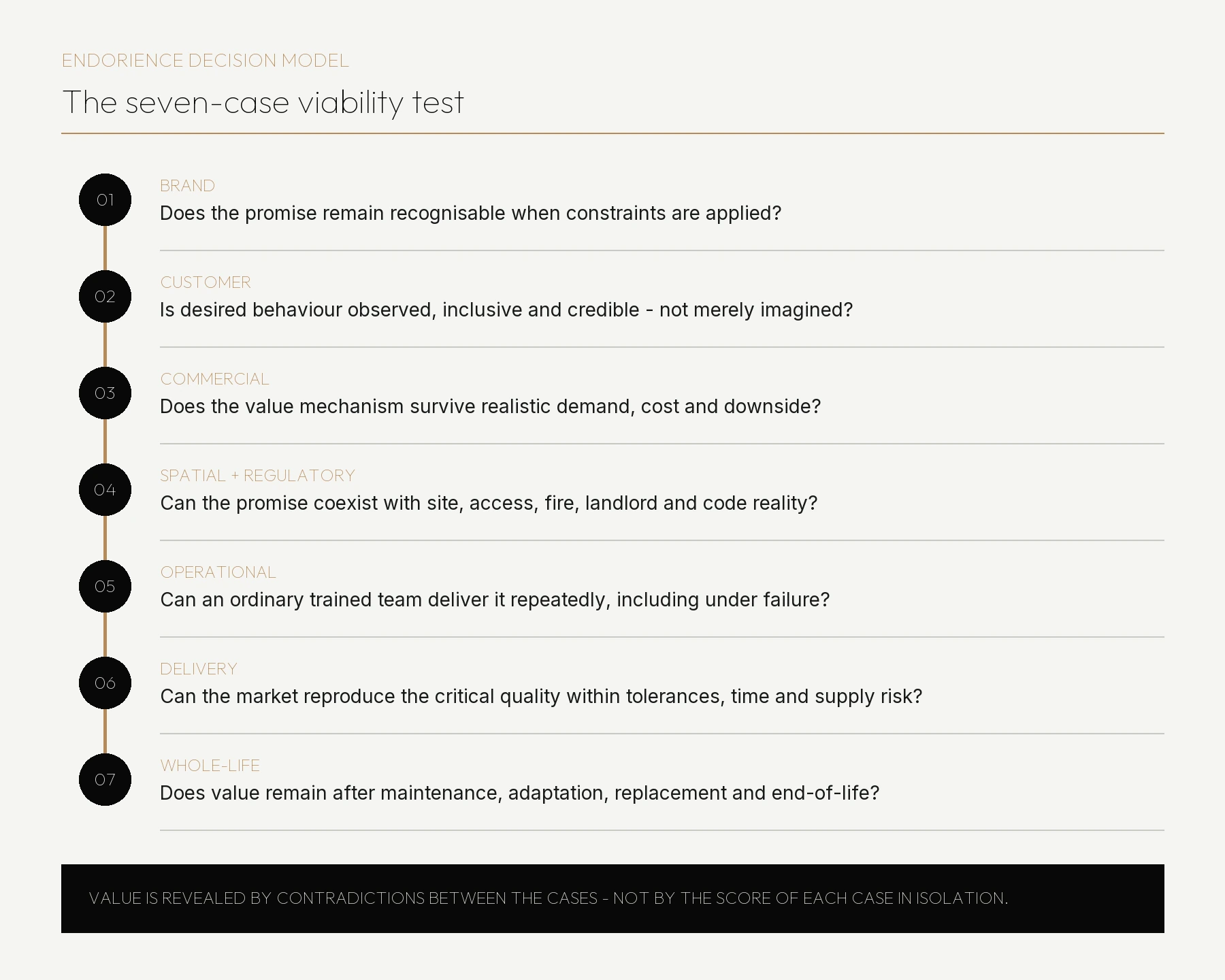
Seven cases, one proposition
Brand viability begins with the promise. What should customers understand, feel or be able to do because this environment exists? Which moments are essential, and which are only one possible expression? Without this distinction, the organisation cannot adapt intelligently when reality applies pressure.
Customer viability tests behaviour rather than internal enthusiasm. Who comes, what do they seek, where does friction arise and who may be excluded? Accessibility is not a late compliance line; it shapes the physical and digital journey. Evidence may come from observation, prototyping and service simulation, not only stated preference. [S07-S10, S21-S23]
Commercial viability makes the mechanism of value explicit. How should the concept influence demand, conversion, productivity, loyalty or portfolio value? What capital and operating consequences follow? What is the base case, and what happens if demand or adoption is lower than expected?
Spatial and regulatory viability recognises that every concept becomes site-specific before it becomes scalable. Structure, utilities, loading, acoustics, fire, access, heritage, landlord requirements and approvals can change the experience. Operational viability then asks whether an ordinary trained team can deliver the promise repeatedly - at opening, peak load, replenishment, failure and close.
Delivery viability tests whether the market can reproduce critical quality. Samples, tolerances, interfaces, lead times, logistics, installation, commissioning and replacement routes matter as much as design intent. Whole-life responsibility asks what remains after launch: durability, maintenance, energy, health, climate exposure, adaptability, repair and end-of-life. [S03, S05-S06, S11-S13]
The seven cases are not scores to be completed independently. Their value lies in the contradictions between them.
FROM ENDORIENCE PRACTICE
The living wall that could not live
In one retail project, living walls had become a central design idea and were extended across several parts of the interior. In drawings and visualisations they created the desired richness and vitality. The concept was persuasive because the finished image was easy to understand.
The actual environment could not support it. Light levels and humidity were unsuitable, and the maintenance conditions required by the planting had not shaped the design. The problem became undeniable only after the first walls were installed. The plants deteriorated and the smell of decaying vegetation entered the store experience.
We were able to stop the wider installation, but only after the first work and cost had been committed. The lesson was not that living walls are unsuitable for premium retail. It was that an attractive material idea had been approved without testing the environmental and operational conditions on which its viability depended.
Test before you promise
Evidence should be proportionate to novelty, uncertainty and reversibility. A familiar format in a known market may need targeted confirmation. An untested service model, new technology or bespoke material system needs deeper evidence before scale.
The instrument should match the question. An experience prototype reveals behaviour and exclusion. A technical mock-up tests quality, tolerances and maintenance. An operational simulation exposes staffing, timing and recovery. A supply-market test reveals capability and lead time. A reference-class view challenges internal optimism with comparable outcomes. A life-cycle hotspot review shows where value or environmental performance deteriorates over time. [S14-S15]
The critical principle is that a test must be able to change the decision. If a prototype exists only to demonstrate the sponsor's preferred answer, it is presentation theatre, not viability evidence.
Responsible ambition has more than two outcomes
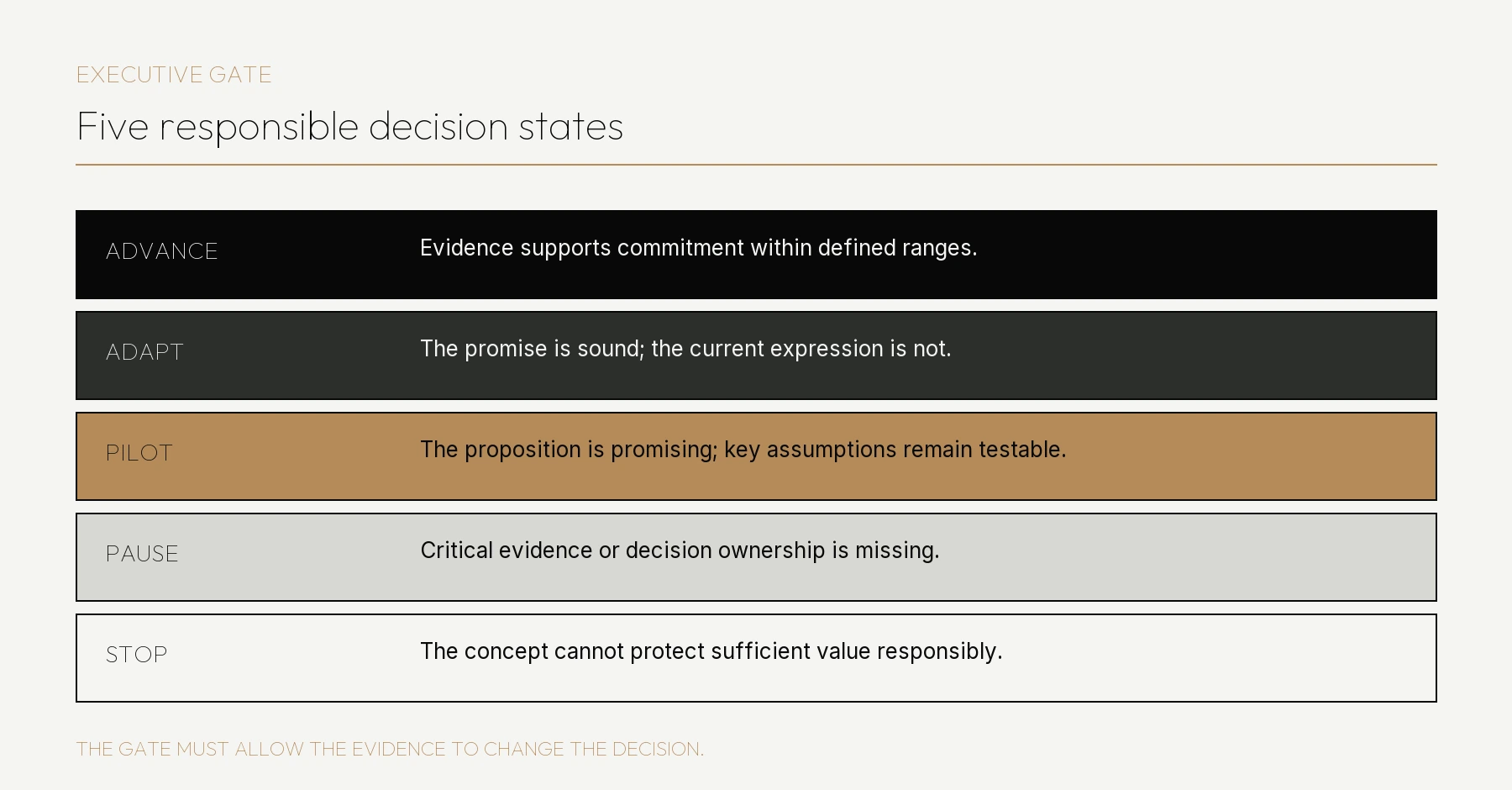
Go/no-go framing forces teams to defend the whole concept or reject it. A more mature gate allows five responses. Advance when the cases support commitment within defined ranges. Adapt when the promise is sound but the current expression is weak. Pilot when important assumptions can be tested through bounded exposure. Pause when critical evidence or ownership is missing. Stop when the concept cannot protect sufficient value responsibly.
Stop is not the only sign that viability work has succeeded. A well-designed adaptation can protect the brand promise more effectively than literal fidelity to the first image. A pilot can prevent the portfolio from repeating an untested operating assumption. A pause can be the fastest route to a credible commitment.
The executive implication
Concept viability does not make premium ambition smaller. It prevents ambition from being consumed by avoidable compromise.
A viable concept is not one that survives a presentation. It is one that can survive reality and remain worth having.
Evidence notes
EVIDENCE USED IN THIS PUBLICATION
S01 ENDORIENCE (2026). Strategic Experience Review and Execution & Budget Review. Source
S02 HM Treasury (2026). The Green Book 2026. Source
S03 UK Cabinet Office (2022). The Construction Playbook. Source
S04 Royal Institute of British Architects (2020). RIBA Plan of Work 2020 Overview. Source
S05 U.S. General Services Administration (2024). Facilities Standards for the Public Buildings Service (P100). Source
S06 European Commission (2026). Level(s): common framework for sustainable buildings. Source
S07 U.S. Department of Justice (2010). 2010 ADA Standards for Accessible Design. Source
S08 Dubai Municipality (2021). Dubai Building Code. Source
S09 Saudi Building Code Center (2024). Saudi Building Code 2024. Source
S10 Singapore Building and Construction Authority (2019). Code on Accessibility in the Built Environment 2019. Source
S11 Infrastructure Australia (2018). Assessment Framework: Business Case Development and Assessment. Source
S12 International Organization for Standardization (2015). ISO 9001:2015 Quality management systems. Source
S13 International Organization for Standardization (2017). ISO 10006:2017 Quality management in projects. Source
S14 Flyvbjerg, Holm & Buhl (2002). Underestimating Costs in Public Works Projects: Error or Lie?. Source
S15 Cantarelli, Flyvbjerg, Molin & van Wee (2010). Cost Overruns in Large-scale Transportation Infrastructure Projects. Source
S16 Harvard Business School (2026). Retail Expansion to International Markets: Why Some Retailers Succeed and Many Fail. Source
S17 LVMH (2026). Universal Registration Document 2025. Source
S18 Inditex (2025). Annual Report 2024. Source
S19 Marriott International (2025). 2025 Serve 360 Report. Source
S21 European Commission (2019 / 2025 application). European Accessibility Act. Source
S22 UK Government (2024). Approved Document M, Volume 2. Source
S23 Dubai Municipality (Current). Dubai Universal Design Code. Source