
EXECUTIVE SUMMARY
KEY TAKEAWAYS
- 01Decision Debt concerns dependent commitments, not merely the number of unanswered questions.
- 02Unresolved choices can become assumed, embedded and expensive to reverse without a formal approval.
- 03Controlled deferral needs authority, an evidence plan, an expiry and a boundary on commitments.
- 04Close the decision and update its dependent work; a signed minute alone does not retire the exposure.
The decision that was never really made
Consider a premium hospitality project in which the arrival experience has been approved but the operating model has not. The design assumes a host-led welcome. The staffing plan assumes guests will largely orient themselves. Technology procurement proceeds on a third assumption: most arrivals will be handled digitally. Each workstream appears to be progressing. Together, they are designing different businesses.
The missing decision is not a minor detail. It determines where people wait, what staff must see, how exceptions are handled and which systems need to communicate. Yet the programme can report completed drawings, a developing budget and a procurement milestone without identifying the unresolved choice. Activity supplies the appearance of closure.
The term describes a governance exposure, not an accounting liability. An unanswered question alone does not create this debt. The defining condition is that work starts relying on an answer that no authorised person has actually chosen, or on a deferral whose limits have not been made explicit. A provisional assumption becomes consequential when other people treat it as permission.
This is also distinct from ordinary project risk. A risk describes an uncertain event or condition and its consequences. Decision Debt identifies a specific missing choice whose assumed answer is already shaping commitments. A decision can therefore generate several risks, while the root governance issue remains one unresolved question. Treating those consequences separately can obscure the intervention that would address them together.
Decision Readiness asks whether evidence is sufficient for the next commitment. Decision Debt examines what happens when commitment outruns that judgement. The distinction matters because faster approval is not necessarily the remedy. An informed decision to wait may protect value. An unexamined decision to continue may spend it.
Why capable organisations carry the debt
Schedule pressure rewards visible progress. Commercial teams need a number, designers need a brief and procurement needs a release. A provisional answer keeps each workstream moving. When no one owns the boundary between their assumptions, a local convenience can become a project-wide condition. The problem is often less a lack of expertise than a lack of authority over the unresolved choice.
There is also an interpersonal cost to reopening a question. A sponsor may have endorsed the concept; a team may have celebrated approval. Saying that the operating model remains undecided can sound like opposition to the project itself. Edmondson’s study of 51 manufacturing teams associated psychological safety with learning behaviour. [2] A team needs room to question an approval before its assumptions become expensive.
ENDORIENCE examines the human dynamics behind the missing decision as well as the formal authority to make it. People respond differently to uncertainty, responsibility and pressure. RISE supports this enquiry with a personality-informed perspective. [4] That perspective helps sharpen the questions: what makes this choice difficult for the people involved, and what would allow them to address it? The answer still has to reach the project record.
How an assumption becomes a commitment
ENDORIENCE traces this exposure through four states. They help a team locate the point at which an unresolved choice starts to constrain its options. Different dependencies can occupy different states, so intervention need not wait for the entire project to reach the same point.
Unresolved: a material choice has no authorised answer. Assumed: a workstream adopts a provisional answer to continue. Embedded: that answer enters drawings, pricing, contracts, interfaces or operating plans. Expensive to reverse: changing it now requires material rework, cancellation, delay or a loss of strategic quality.
The most useful signal is the transition from assumed to embedded. A designer’s working hypothesis can be inexpensive to replace. The same hypothesis in a released purchase order acquires commercial consequences. The label on the decision may still say “to be confirmed” while its dependencies are already behaving as if it were final.
The customer journey no one joined up
FROM ENDORIENCE PRACTICE
In one premium customer-service environment, the interior had been carefully designed. Functions were separated, materials considered and built-in elements planned for their intended tasks. The operator had also developed a service model intended to serve customers with minimal resources. The designer had not asked the operator about customer flow; the operator had not communicated that flow to the designer.
At arrival, an AI-assisted registration terminal collected customer details and created a queue entry in the background. A first name was sufficient for service. The screen thanked the customer for registering, but provided no paper ticket or visible queue number. Customers had entered the system without receiving a clear reference for what would happen next.
One small display, poorly positioned towards the shopfront, showed who should proceed to one of around fifteen service counters. Customers gathered in the shopping-centre corridor to watch it. Staff called out to find the right person in the waiting crowd. The environment designed for a premium experience had acquired the sound and uncertainty of an improvised queue.
The consequence extended beyond inconvenience. Customers waiting outside looked at neighbouring shop windows instead of discovering the products deliberately positioned inside. Staff attention went into locating customers. The intended saving in service resources had created additional coordination work at the point of use.
The Decision Debt lay in the missing shared decision about the complete journey: how a customer registers, knows what to expect, waits, receives a call and reaches the correct counter. Separate design and operating assumptions became physical and digital commitments before that journey had been reconciled. The technology was one component of the mismatch, not its explanation.
A joint walkthrough before release could have tested arrival, confirmation, display visibility, waiting location and staff intervention together. That was the opportunity to resolve the missing decision before customers and staff had to live with its consequences.
Where the cost becomes visible
In the arrival scenario, a later decision to provide a personal welcome could require a different desk location, revised power and data, more staff space and new software integration. Each change may be reasonable on its own. The combined effect exposes the earlier failure to decide the service model before releasing dependent work. The loss belongs to the dependency chain, even when invoices arrive from different suppliers.
Look for this exposure in procurement and engineering, then follow it into production and site work. The point at which options narrow depends on the contract and the lead time. A bespoke order may close an option well before installation; a standard component may remain easy to replace. Leaders need to know which condition applies to the release in front of them.
Time matters through these dependencies, not simply through age. An unanswered question can remain harmless for weeks if nothing relies on it. Another can acquire serious exposure in a day when several packages adopt the same untested answer. Counting overdue decisions is useful administration; tracing what has become dependent on them is the more important diagnostic.
Keep three categories separate: realised cost already incurred, prospective exposure if the assumption changes, and strategic impairment if the organisation accepts a weaker outcome. A service experience that loses privacy may not produce an immediate variation order, yet it can undermine the purpose of the investment. Treat that consequence explicitly without inventing a financial value for it.
Decision Debt is not flexibility
A controlled option has an owner, a reason for remaining open, a plan for obtaining evidence and a limit on what can be committed meanwhile. It also has an expiry: a date or event after which waiting changes the consequences. Those conditions turn deferral into an authorised decision about how to manage uncertainty.
NASA’s decision-analysis guidance makes assumptions, alternatives and uncertainty explicit and relates analytical effort to the consequences of the choice. [1] The lesson for premium projects is proportionality. Do not freeze every detail to create a clean dashboard. Identify the choices that could materially change the next commitment and protect the ability to revisit the rest.
An approved mock-up may therefore be a better next step than a full manufacturing release. It buys evidence while containing exposure. Conversely, calling a release “conditional” offers little protection if the supplier has already ordered non-returnable material. A condition is only useful when the permitted commitment respects it.
A record that changes the next release
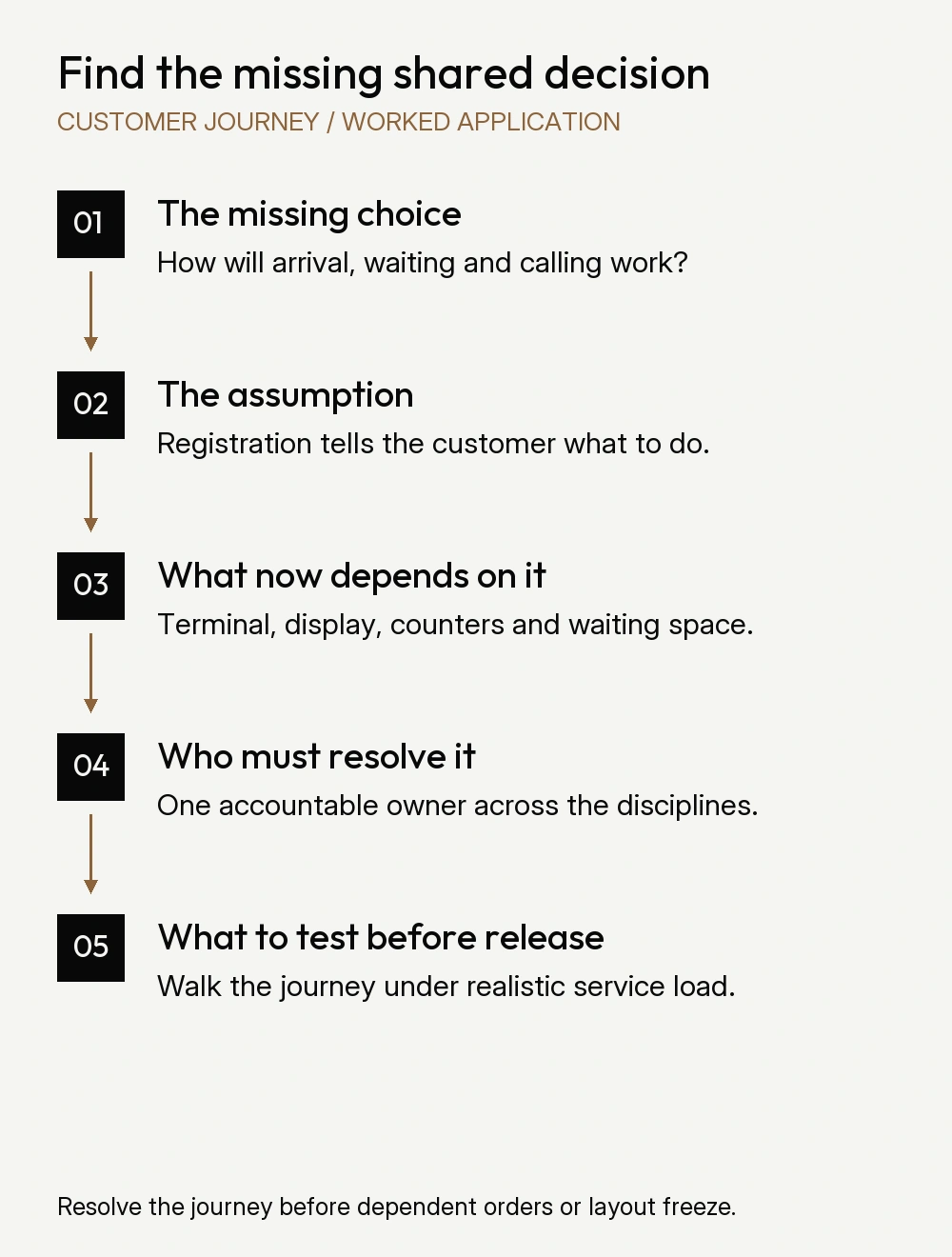
The customer-journey case shows what the record needs to capture. A useful response would begin with the shared journey and the commitments that still depend on it.
Start with the release that can still be controlled. If the display and terminal have not been ordered, test their relationship with waiting and service before procurement. If installation has already occurred, record the resulting constraints and assess the remaining options rather than pretending the original flexibility still exists.
Assign one authority to resolve the shared journey, with design, operations and technology contributing evidence. The record closes only when the chosen arrangement has reached the drawings, supplier instructions and operating procedure. A decision in meeting minutes is insufficient if each workstream continues using a different answer.
Closure should also produce learning. Compare the assumption with the eventual evidence, record why it escaped scrutiny and identify the earlier gate that could have caught it. Over time, that record can reveal recurring dependency failures. Until enough comparable observations exist, it should inform professional judgement rather than support claims of a universal debt index or predictive benchmark.
Make the exposure governable
Begin with the next consequential release, not an exhaustive inventory of everything unknown. Ask the people preparing it which assumptions must be true for it to make sense. Trace each material assumption to an authorised decision or a bounded deferral. Where neither exists, record the missing choice and the work already depending on it.
A useful Decision Debt record contains the decision question, current assumption, accountable authority, affected dependencies, next commitment boundary, evidence needed, resolution date or trigger, and consequence of being wrong. Add the evidence source and confidence level. This record should connect to the existing risk, change and decision logs rather than create a competing reporting system.
Prioritise by consequence and proximity to lost options. A modest unresolved detail with a manufacturing release tomorrow may deserve attention before a large strategic question whose options remain open. Where evidence is weak, show a range or a qualitative consequence. Do not multiply subjective scores into a monetary-looking “debt total” that implies precision the organisation does not possess.
HM Treasury’s appraisal guidance recommends examining uncertainty and sensitivity in assumptions. [3] Applied here, that means asking what change in an assumption would overturn the proposed commitment. The organisation can then commission a targeted test, choose a different route or accept a bounded exposure. The relevant question is the value of better evidence before the next release.
Resolution requires more than a recorded answer. Update the affected drawings, scope, budget, supplier instructions and operating plans, then verify that the people acting on the former assumption have received the change. Otherwise the decision closes administratively while its obsolete version continues to shape delivery.
The executive implication
A board does not need every open question. It needs visibility of the decisions whose absence is already allocating capital, constraining delivery or changing the promised experience. The decisive question is: which decisions is the organisation already paying for without having actually made them?
Sources and research notes
- NASA. Systems Engineering Handbook, section 6.8: Decision Analysis. Guidance on alternatives, uncertainty, decision criteria and records.
- Amy Edmondson (1999). Psychological Safety and Learning Behavior in Work Teams. Administrative Science Quarterly 44(2), 350–383. Field study of psychological safety and learning behaviour in 51 manufacturing teams.
- HM Treasury (2026). The Green Book, chapters 4 and 6: objectives, appraisal, sensitivity and optimism bias. Appraisal guidance on uncertainty, sensitivity and assumptions.
- RISE Analysis. Business Solutions: personality-informed individual and team analysis. Personality-informed individual and team analysis.