EXECUTIVE SUMMARY
Global brand consistency does not require identical stores. It requires a stable promise, a clear boundary of adaptation and evidence that each local solution produces an equivalent customer and operating outcome.
This paper explains how premium brands can define invariants, bounded choices and genuinely local decisions before rollout. It connects cultural behaviour, regulation, supply, operations and governance so that adaptation remains intentional and scale is released through evidence rather than assumption.
KEY TAKEAWAYS
- 01The prototype is one expression of the brand, not the complete definition of the brand.
- 02Global consistency is controlled equivalence, not identical output.
- 03Cultural behaviour, privacy, regulation, supply and operations must shape local expression within explicit boundaries.
- 04The organisation should approve what is invariant, bounded and local before accelerating rollout.
How a global brand stays coherent across different markets, codes and operating systems
A FAMILIAR SITUATION
The second store changes the question
The flagship works. Its sequence is distinctive, its materials feel resolved and its service has become visible to customers. The design team captures every detail in a standards package so the next markets can reproduce the success.
The second site has a lower slab, a different fire strategy, longer import routes and a landlord with its own approved systems. The local customer expects more privacy in service. The operating partner uses a different staffing model. To preserve the drawing, the project accumulates exceptions. To preserve the opening date, those exceptions become substitutions. By launch, the store looks familiar but the choices that changed the experience are scattered across emails and site instructions.
The first store proved that one expression could work in one reality. The second reveals the real rollout problem: how does the organisation protect the same promise when reality changes?
The prototype is not the brand
A successful flagship creates a powerful temptation. The environment appears to contain the formula: dimensions, materials, fixtures, lighting, technology and service positions. The rollout task seems to be documentation followed by repetition.
But the next market does not receive the same code, site, climate, contractor base, supply ecosystem, customer behaviour, labour model or payment environment. Literal reproduction therefore creates a false choice. Either local teams protect the drawing and absorb cost, delay or impracticality, or they protect delivery and change the proposition invisibly.
Unlimited localisation is no better. If each market solves the whole concept again, the brand fragments and the portfolio loses procurement leverage and learning. The leadership task is not to choose standardisation or localisation. It is to govern the boundary between them.
Research on international retail describes the need for balanced adaptation: identify the elements that make the model work, then adapt where the market structurally demands it. The practical implication is clear. Leadership must draw the boundary before entry, or the market will draw it later and more expensively. [R02]
Write the constitution before the exceptions
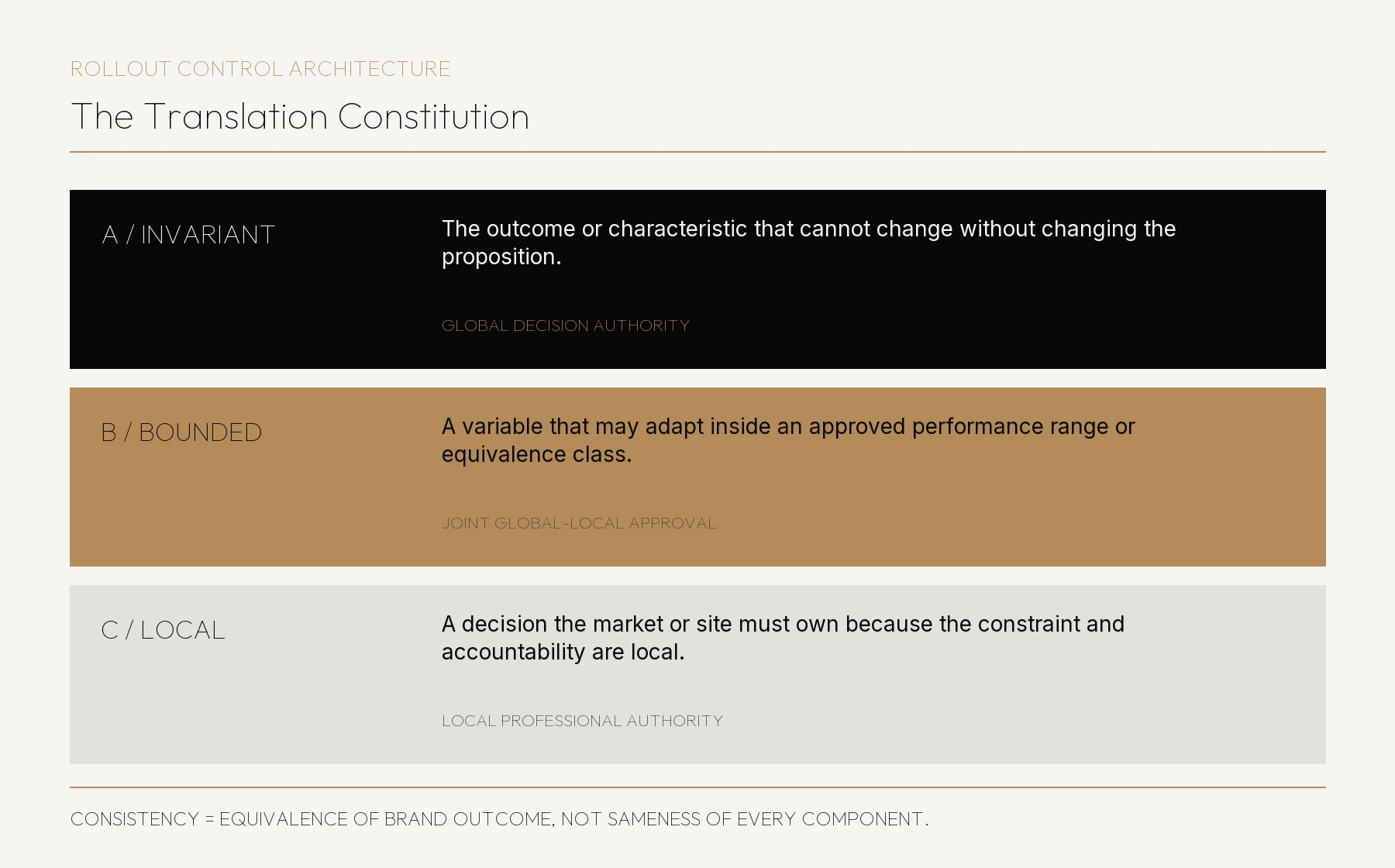
A rollout needs a Translation Constitution before it needs a thicker brand book. The constitution classifies standards by the authority they carry, the evidence required to change them and the people entitled to decide.
Invariants are the few outcomes or characteristics that cannot change without changing the proposition: perhaps the role of human service, a signature sequence, material authenticity, privacy, responsible sourcing or data integrity. They should be stated as value and performance, not as a catalogue of components.
For example, 'use this exact stone' is fragile. 'The primary customer touch surface must communicate natural material integrity, age predictably and be repairable to the brand standard' defines what the solution must achieve. It protects the intention while allowing evidence-led equivalence.
Bounded variables may adapt inside approved ranges. Fixture families, lighting performance, material equivalence classes, regional technology stacks and service variations can be designed in advance. Local variables belong with the market because the constraint and professional accountability are local: permits, lease conditions, language, utilities, climate detailing, payment, labour, security and logistics.
Local authority is not freedom from standards. It is accountable translation inside global outcomes.
FROM ENDORIENCE PRACTICE
One jewellery brand in two social settings
While working with a jewellery brand across Europe and the Middle East, we saw that the same brand promise could not be expressed through the same balance of visibility and privacy. The difference was not cosmetic. It affected how clients expected to enter, consult, try on and decide.
In specific Middle Eastern markets and client groups, discretion carried greater value. The environment needed more private consultation space and stronger separation from the public retail floor. In the European locations we studied, the purchasing moment could be more visible and socially expressive. Customers were more comfortable seeing how a piece appeared in a shared setting and allowing that moment to form part of the experience.
The answer was not to create different brand identities. It was to translate the same standards of recognition, care and confidence into different spatial conditions. Consistency came from protecting the promise while allowing local behaviour to change the layout.
Make local reality visible early
Every market should enter the rollout through the same Market Reality Dossier. The structure is global; the evidence is local. Customer behaviour, service norms, privacy, accessibility, regulation, real estate, operations, supply, commercial exposure and climate are examined before design assumptions become commitments.
Regulatory variation alone makes one universal detail library insufficient. Accessibility and building requirements in the US, UK, EU, Dubai, Saudi Arabia, Singapore and Australia operate through different systems and accountabilities. The global standard should therefore require early investigation and professional approval while keeping the intended customer outcome visible. [R09-R16]
The dossier is not a collection exercise. Its role is to identify which global assumptions still hold, which require adaptation and which could invalidate the operating or investment model. It gives the local team a legitimate place in design before late pressure turns local knowledge into an exception request.
Release scale through evidence
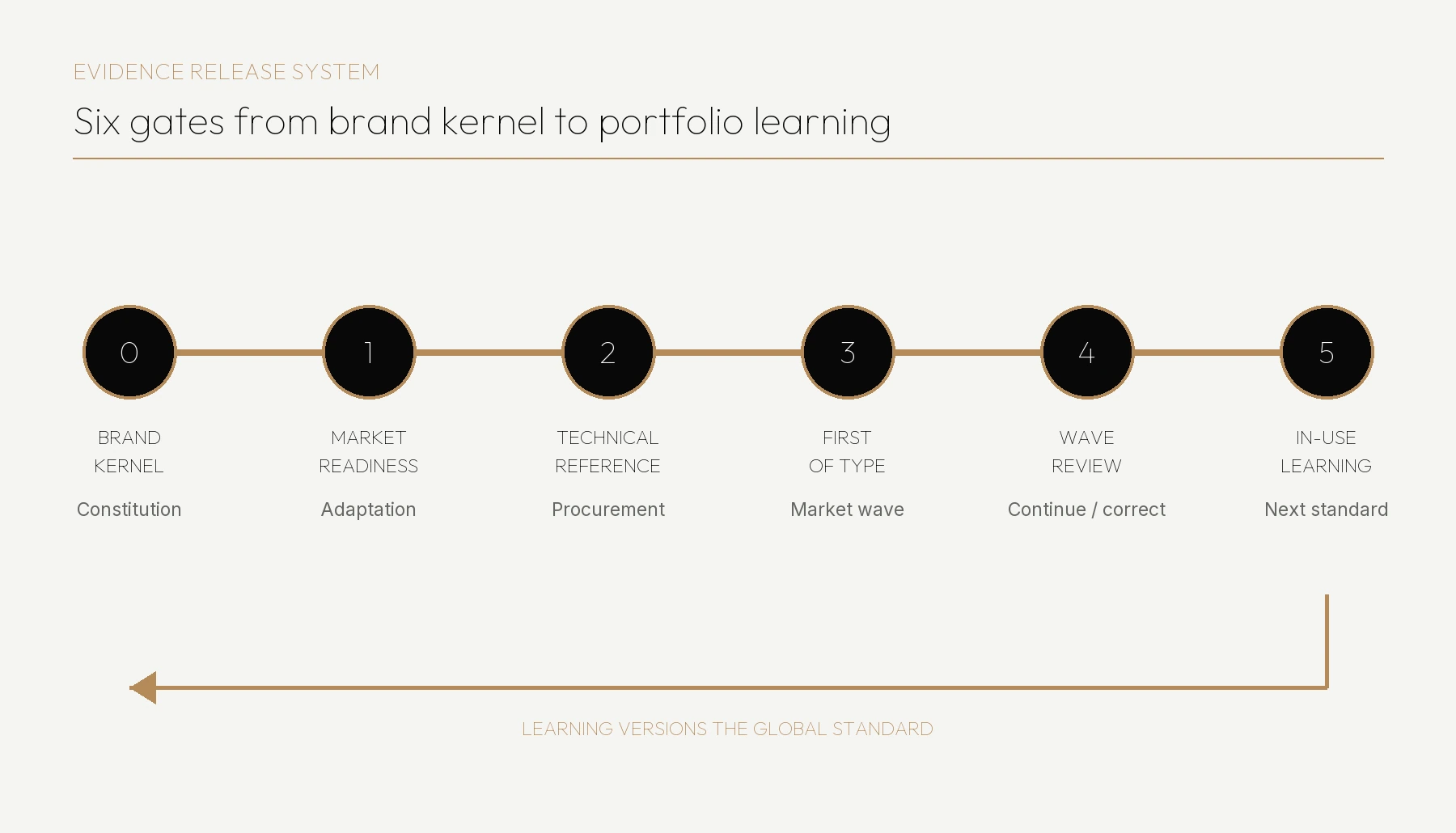
A global prototype proves design intent. It does not prove local approvals, supply, installation, operations or customer response. Scale should therefore move through evidence gates: define the brand kernel; establish market readiness; validate the local technical reference; prove a first of type; review the wave; and use in-use evidence to version the next standard.
The first-of-type store must be allowed to teach. If its purpose is only to confirm a rollout date already announced, the organisation will scale the narrative instead of the evidence. Defects, workarounds and customer behaviour will be described as local anomalies even when they reveal a global assumption.
Portfolio learning requires version control. A local decision that repeatedly creates better value should become part of the standard. A global detail that repeatedly fails should lose authority. Quality systems are useful here because they separate consistent control from uniform output: responsibilities, evidence, measurement and improvement can be standard even when the physical answer changes. [R03-R05]
The operating system protects the brand
A rollout is often managed as a design-document programme. In reality, coherence depends on the operating system around the documents. Global design authority owns the brand kernel, ranges and equivalence criteria. Local professionals own jurisdictional truth. Commercial control maintains a common cost taxonomy while local teams validate duties, rates and volatility. Supply quality defines critical characteristics globally and qualifies actual fabricators locally.
This is not a central-versus-local compromise. It aligns authority with knowledge while preserving one accountable system. The board view should therefore show more than store count and opening dates. It should expose unresolved invariant deviations, first-of-type learning, cost and time movement by cause, supplier and replacement risk, operational readiness and local decisions proposed for global adoption.
The purpose is not another dashboard. It is to make visible the decisions that require leadership before local pressure silently changes the proposition.
The executive implication
A global brand does not remain coherent because every market receives the same drawing set. It remains coherent because the organisation knows what the brand is promising, gives local reality a legitimate place in design and governs every consequential change against that promise.
Same brand. Different reality. One accountable standard of judgement.
Evidence notes
EVIDENCE USED IN THIS PUBLICATION
R01 ENDORIENCE (2026). ENDORIENCE positioning and consulting products. Source
R02 Harvard Business School (2026). Retail Expansion to International Markets: Why Some Retailers Succeed and Many Fail. Source
R03 International Organization for Standardization (2015). ISO 9001:2015 Quality management systems. Source
R04 ISO/TC 176 (2015). The process approach in ISO 9001. Source
R05 GS1 (2025). GS1 Global Data Model. Source
R06 LVMH (2026). Universal Registration Document 2025. Source
R07 Inditex (2025). Annual Report 2024. Source
R09 U.S. Department of Justice (2010). 2010 ADA Standards for Accessible Design. Source
R10 UK Government (2024). Approved Document M, Volume 2. Source
R11 European Commission (2019 / 2025 application). European Accessibility Act. Source
R12 Dubai Municipality (2021). Dubai Building Code. Source
R13 Dubai Municipality (Current). Dubai Universal Design Code. Source
R14 Saudi Building Code Center (2024). Saudi Building Code 2024. Source
R15 Singapore BCA (2019). Code on Accessibility in the Built Environment 2019. Source
R16 Australian Building Codes Board (2025). National Construction Code. Source
R20 Marriott International (2025). 2025 Serve 360 Report. Source
R22 LVMH (2026). DFS brand and network profile. Source
R23 LVMH (2023). Sephora Shanghai Store of the Future. Source