EXECUTIVE SUMMARY
Capable leadership teams can still make weak decisions when the system around them filters out unique information, discourages challenge or reports only the variables that appear under control. Agreement is not evidence that the full consequence of a decision has been understood.
This paper sets out a practical leadership decision system: frame the decision, surface distributed knowledge, legitimise dissent, clarify authority, match pace to consequence and define how later evidence can reopen the judgement.
KEY TAKEAWAYS
- 01Decision quality depends on the information and challenge system, not only on individual competence.
- 02Budget and programme can remain on target while quality and strategic intent deteriorate.
- 03Leaders need explicit visibility of what changed, who accepted it and what consequence follows.
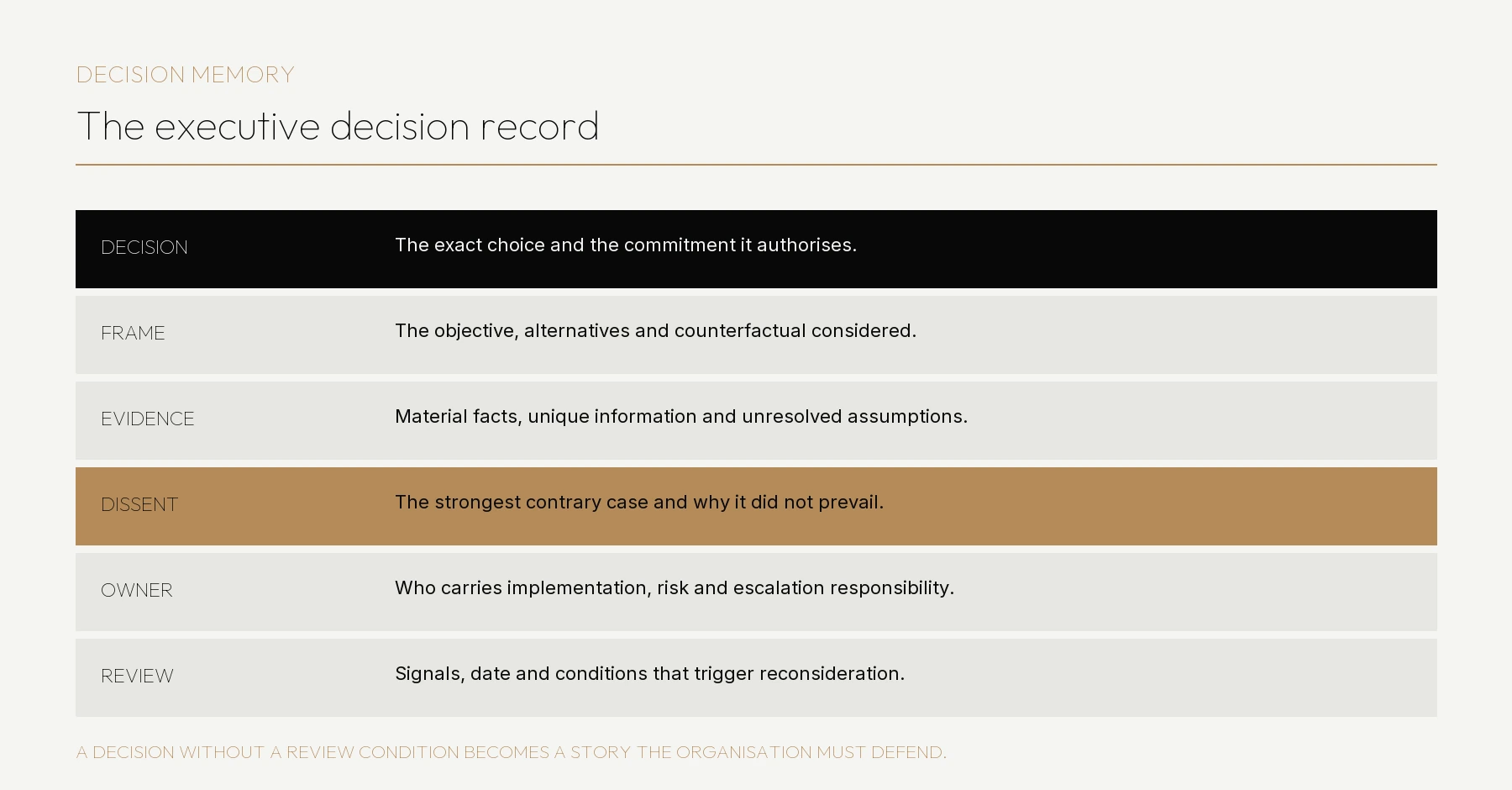
- 04Every consequential decision should include a review condition that allows reality to correct the judgement.
Designing the conditions in which expertise becomes collective judgement
A FAMILIAR SITUATION
Everyone agreed. No one had seen the whole picture.
The decision meeting is calm, experienced and efficient. Brand supports the proposal. Finance has reviewed the return. Operations believes the team can deliver. Design is confident in the concept. The group reaches alignment faster than expected.
After the meeting, separate conversations reveal what the room did not use. The local team knew that the proposed service ritual conflicted with peak customer behaviour. Procurement knew the critical supplier had not delivered the required tolerance at volume. Finance had modelled the downside, but presented only the base case because the recommendation seemed settled. No one withheld information deliberately. The meeting simply had no mechanism for making unique or disconfirming information decisive.
This is the uncomfortable truth about executive work: capable people do not automatically produce capable collective judgement. Expertise is an input. The decision environment determines whether the organisation can use it.
Competence does not aggregate automatically
Leadership teams are assembled because no individual holds the complete answer. Strategy, brand, finance, operations, design, technology, legal and delivery each see a different part of the system. Discussion should integrate these perspectives. In practice, it often rewards what is already shared.
Hidden-profile research found that groups tend to discuss information known by several members and information consistent with initial preferences, while unique evidence remains underused. A later meta-analysis across 65 studies reinforced that this is a persistent feature of group decision-making, not a rare interpersonal failure. [L03-L04]
Psychological safety is essential because people must be able to admit uncertainty, report bad news and challenge authority without punishment. Yet safety alone does not frame the right question, expose unique information or clarify who decides. A friendly room can still make a structurally weak decision. [L02]
Design the room before asking it to decide
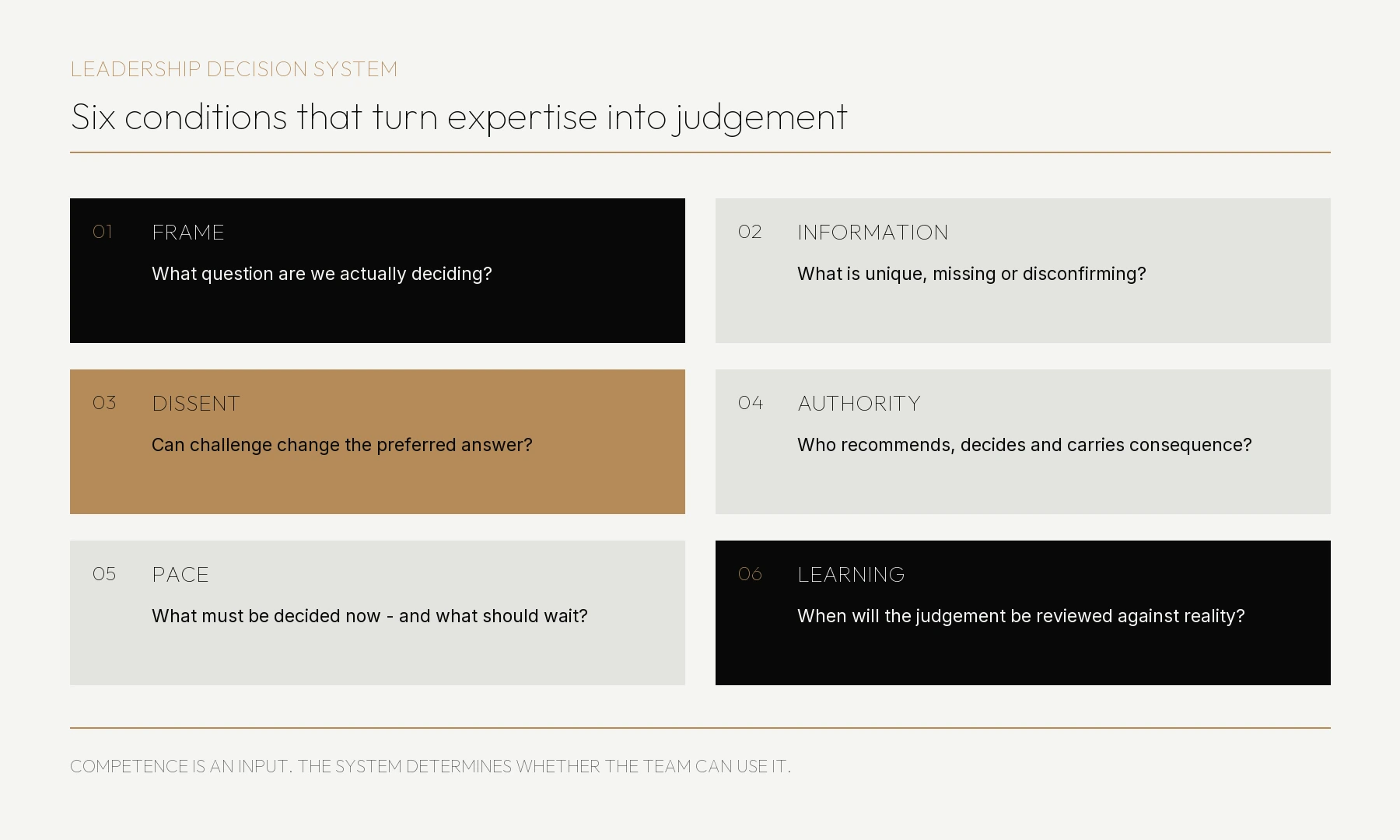
The first condition is the frame. State the exact decision, objective, alternatives, constraints and consequence of delay. Separate the question from the proposal already on the table. A useful test is simple: what would we ask if the current recommendation did not exist?
The second is information. Evidence, inference and preference should be distinguishable. Unique local knowledge and disconfirming facts should be surfaced before discussion converges. Pre-reads can help, but only if they expose assumptions and differences rather than present a polished case for approval.
The third is dissent. Challenge must have a procedural role, not depend on personal courage. The chair can ask for the strongest contrary case, assign a pre-mortem or require an alternative recommendation. Research in hidden-profile settings suggests dissent can improve information processing; the executive implication is to design legitimate challenge, not to romanticise conflict. [L05-L06]
Authority is the fourth condition. The people who frame, recommend, advise, decide, execute and review should be explicit. Ambiguity creates two opposite failures: consensus theatre, where everyone appears to decide and no one carries consequence; or authority theatre, where consultation occurs after the answer is already fixed.
Pace is the fifth. Urgency should be connected to the cost of delay, not to anxiety or meeting cadence. Some decisions improve through a short pause for evidence. Others deteriorate if leadership keeps requesting analysis after the remaining uncertainty is understood. The sixth condition is learning: every material judgement needs a review point and a signal that can reopen it.
FROM ENDORIENCE PRACTICE
The information leadership never received
In one office project, the leader responsible for approval received two reassuring facts: the price remained within budget and delivery remained on schedule. What did not reach the decision was that the proposed route had changed the quality of the furniture.
The project proceeded, and every headline indicator remained positive. At opening, the physical result made the gap visible. The materials, detailing and execution fell below the agreed expectations. By then the issue was no longer a difference of professional opinion; it was present throughout the completed office.
The full furniture package had to be manufactured again. The failure was not that leadership chose cost and time over quality. Leadership was never shown that choice. A decision system that reports budget and programme while suppressing a material change in quality gives the decision-maker confidence without the information required for judgement.
Better meetings are not the objective
A decision system is not a meeting protocol imposed on every choice. Its form should be proportionate. A reversible operational adjustment may need a clear owner and a short review loop. A major lease, acquisition, concept commitment or global rollout needs a richer frame, independent evidence and explicit dissent.
Nor should the system eliminate leadership judgement. Data does not decide how ambition, risk, timing and brand value should be balanced. The system improves the conditions under which judgement is exercised. It ensures that the relevant expertise can enter, that authority is legitimate and that the organisation can learn without rewriting history.
Governance codes across the UK, OECD, Saudi Arabia and Australia emphasise timely information, constructive challenge, clear responsibility and effective oversight. These principles matter beyond the boardroom. They describe the operating conditions required wherever complex decisions cross functions and markets. [L07-L10]
The executive implication
The highest-performing leadership team is not the one that reaches agreement fastest. It is the one that can distinguish alignment from convergence, confidence from evidence and commitment from defensiveness.
Competence is an input. The system determines whether it becomes judgement.
Evidence notes
EVIDENCE USED IN THIS PUBLICATION
L01 ENDORIENCE (2026). ENDORIENCE consulting products. Source
L02 Amy Edmondson (1999). Psychological Safety and Learning Behavior in Work Teams. Source
L03 Stasser & Titus (1985). Pooling of Unshared Information in Group Decision Making. Source
L04 Lu, Yuan & McLeod (2012). Twenty-Five Years of Hidden Profiles in Group Decision Making. Source
L05 Schulz-Hardt et al. (2006). Dissent as a Facilitator for Decision Quality. Source
L06 Gary Klein / Harvard Business Review (2007). Performing a Project Premortem. Source
L07 OECD (2023). G20/OECD Principles of Corporate Governance 2023. Source
L08 Financial Reporting Council (2024). UK Corporate Governance Code 2024. Source
L09 Saudi Capital Market Authority (2023 amendment). Corporate Governance Regulations. Source
L10 ASX Corporate Governance Council (2019). Corporate Governance Principles and Recommendations, Fourth Edition. Source
L11 International Organization for Standardization (2018 / confirmed 2023). ISO 31000:2018 Risk management - Guidelines. Source