EXECUTIVE SUMMARY
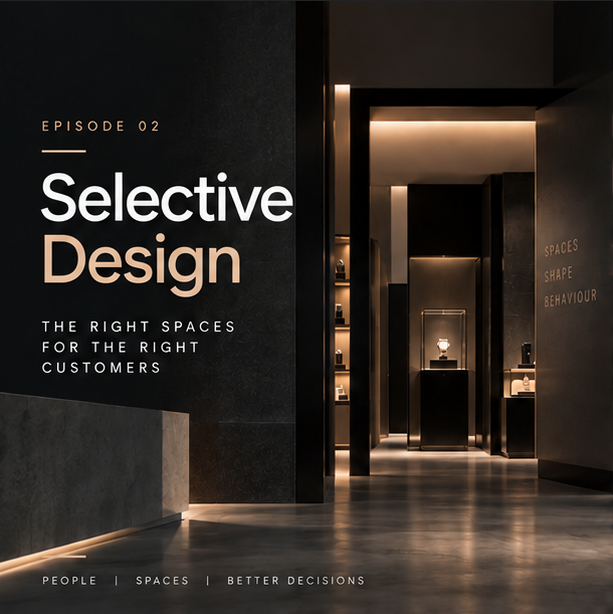
Premium space is becoming increasingly selective.
For decades, retail environments were designed around a relatively simple objective: attract as many potential customers as possible and make them feel welcome. In premium and luxury markets, that logic is changing. Brands are becoming more deliberate about understanding exactly who their most relevant customers are and creating environments specifically around their expectations, behaviours and purchasing patterns.
This does not necessarily mean excluding everyone else. The more sophisticated approach is to create different levels of experience within the same environment. Public-facing areas can remain accessible and reinforce brand visibility, while private rooms, appointment-based experiences and highly personalised service environments provide another level of engagement for selected customers.
Material quality alone is therefore no longer enough to define luxury. Execution quality, detailing, lighting, acoustics, scent, spatial proportions and the way products are presented collectively determine whether an environment feels genuinely premium. Customers may not consciously identify every detail, but they experience the combined effect.
Technology adds another layer. AI and behavioural data can increasingly help brands understand how customers move through spaces, interact with products and respond to different environments. This creates the possibility of designing spaces around much more specific customer profiles rather than generic assumptions.
The strategic challenge is balance. Excessive exclusivity can distance a wider audience and ultimately damage brand perception. Effective selective design therefore does not simply decide who belongs and who does not. It creates a hierarchy of experiences while maintaining a coherent brand environment.
The implication is significant: the strongest premium spaces are no longer designed for everyone. They are designed with a precise understanding of who matters, while ensuring that the wider brand remains desirable.
KEY TAKEAWAYS
- 01Premium design is becoming more selective.
- 02Luxury is experienced through execution, not materials alone.
- 03One brand can support different levels of experience.
- 04Selectivity must not become exclusion.
TRANSCRIPT (EDITED)
KEVIN
Welcome back to the ENDORIENCE Podcast, where we explore how experiences drive customer engagement.
In our first episode, we discussed how point of sale has evolved beyond transactions into something far more immersive.
Today, we’re diving into a related but even more strategic transformation: selective design—the way business spaces are intentionally crafted around a specific clientele.
This concept isn’t new. Luxury retailers, high-end car showrooms and private financial institutions have been doing it for decades. But as markets become increasingly differentiated, more businesses are adopting selective design principles to reinforce exclusivity or create environments for specific customer groups.
Joining me again is Gergő Nidermayer.
Welcome back, Gergő.
GERGŐ
Thanks, Kevin. Great to be here again.
KEVIN
Businesses have always cared about making customers feel comfortable. But now brands seem to be much more deliberate about exactly who they make comfortable.
Does that match what you’re seeing in the industry?
GERGŐ
Absolutely.
A long time ago, many companies wanted to welcome everyone into their stores.
Nowadays, particularly in luxury, brands have become much more focused. They don’t necessarily want people simply walking around without engaging with the brand or the products.
They want to focus on the customers who matter most to them.
KEVIN
What does that selection actually look like in design?
GERGŐ
Historically, the first indication of a premium environment was premium material usage.
If you wanted to create a luxury store, you used real wood, real copper, real steel and other authentic materials.
But that isn’t enough anymore.
Today, you also have to focus on the details.
You can have a store filled with real wood furniture, but you still need to consider how the edges are made, how the joints are executed, which materials are used to integrate the furniture into the space, how the lighting works and how the products themselves are presented.
It’s no longer just about specifying expensive materials.
KEVIN
So the customer ultimately feels that significant time, money and design thinking have been invested in the environment.
GERGŐ
Yes, although many customers may not consciously recognise every individual detail.
But the relevant premium or luxury customer will feel the difference between something that uses expensive materials but is poorly executed and something that is genuinely designed and executed as luxury.
KEVIN
Do some businesses use expensive materials but fail on execution?
GERGŐ
Yes.
Sometimes businesses try to look luxurious without genuinely operating at that level.
And in those situations, pretending to be luxury can actually be worse than not trying to be luxury at all.
KEVIN
How does this connect to wider economic trends?
If brands cannot realistically design for everyone, are they becoming more focused on the customers who genuinely feel comfortable in these environments?
GERGŐ
Exactly.
If you try to create something for everyone, eventually you create very little specifically for the smaller group of people who can actually afford the luxury product.
KEVIN
So you need to target the target group.
GERGŐ
Exactly. You need to target the target group.
It is much more focused than before.
You need to understand what you want to sell and how you want to sell it.
Technology and AI can also help us create environments that are increasingly relevant to specific customers.
KEVIN
How are you using AI in that process?
GERGŐ
Like many companies, we initially started using AI for design—to create and explore spaces faster.
But we soon realised that AI is much more than simply generating images.
It can help collect and analyse data: how customers look at products, how they move around a store, what they interact with and what they want to see.
That information can then help us create environments for much more specific customer profiles.
KEVIN
Is this mainly happening in luxury fashion?
GERGŐ
No. I think most upper-market industries are affected.
You see it in high-end automotive showrooms, healthcare, financial services and other premium environments.
KEVIN
And you experience that immediately when you enter?
GERGŐ
If you belong there, you feel it.
That is actually more important than seeing it.
If you consciously see every design detail, you are probably looking at the environment as an expert.
The customer should primarily feel it.
KEVIN
Are these environments becoming more exclusive?
GERGŐ
Yes.
Because experiences are becoming increasingly detailed and tailored, we are seeing more small rooms, VIP rooms and private spaces designed around individual customers.
KEVIN
So it becomes a tiered experience.
The main showroom might still be accessible, but selected customers are invited into a private environment.
GERGŐ
Exactly.
A brand still needs visibility and relevance beyond the small group of customers who can afford its most exclusive products.
But within that environment, you can create a significantly more private and luxurious experience for selected customers.
KEVIN
What does that look like in a luxury watch store?
GERGŐ
You might have many products in the main retail area, often without prominent price or sales tags.
But a customer who already has a relationship with the brand may know that there is a private space and personalised service available.
They may have their own concierge or sales representative who understands exactly what they are looking for.
KEVIN
And then they are taken into a private room?
GERGŐ
Exactly.
Those private rooms are usually much more comfortable than the standard presentation areas.
There is more space. The customer can feel at home.
They can examine and try the product privately and spend time making the decision.
Usually it is just the customer, the sales representative and perhaps someone accompanying them.
KEVIN
Can brands take this too far?
GERGŐ
Definitely.
A common mistake is becoming so focused on extreme luxury that the brand starts alienating everyone else.
That can create negative feelings towards the brand.
KEVIN
How do you avoid that?
GERGŐ
You shouldn’t focus exclusively on the narrow target audience.
The brand still needs to present itself to the wider public.
That visibility helps maintain and strengthen the brand.
The better approach is often an open environment for a broader audience, with more exclusive spaces reserved for particular products and customers.
KEVIN
Where do you see selective design going next?
GERGŐ
AI will definitely play a role.
But I also think retail will become more membership- and appointment-oriented.
Customers will increasingly arrive already knowing what they are interested in because they have researched products online.
The physical environment therefore needs to be prepared for a much more focused customer journey.
In genuine luxury, appointments are already becoming increasingly important—not only for cars or very large purchases, but also for watches, jewellery and similar products.
KEVIN
Beyond aesthetics, how do you influence the customer psychologically through design?
GERGŐ
We can think about it as psychological environment design.
You need to understand your target audience and how they respond to different sensations.
That includes lighting, music, smell, materials and essentially everything around them.
A green, natural environment creates a very different feeling from a stainless-steel environment with colder materials.
KEVIN
So you are effectively designing across all the senses.
GERGŐ
Exactly.
It needs to be a 360-degree experience.
You need to consider what the customer sees, hears, smells, touches and ultimately how the entire environment makes the product feel.
KEVIN
How do you maintain brand consistency when designing stores in Paris, Berlin, New York or other markets while still responding to local customers?
GERGŐ
That is one of the difficult points.
The brand needs to remain consistent, but people in different parts of the world have different expectations and different cultural associations.
So the core identity can remain the same while the experience around it needs to respond to the market.
KEVIN
Selective design is clearly becoming a powerful tool, but also a complex one to navigate.
GERGŐ
Absolutely.
For those of us creating luxury environments, one of the most important objectives is to make the right customer feel completely at home.
KEVIN
Thank you again, Gergő.
We’ll be back soon with our next episode.