EXECUTIVE SUMMARY
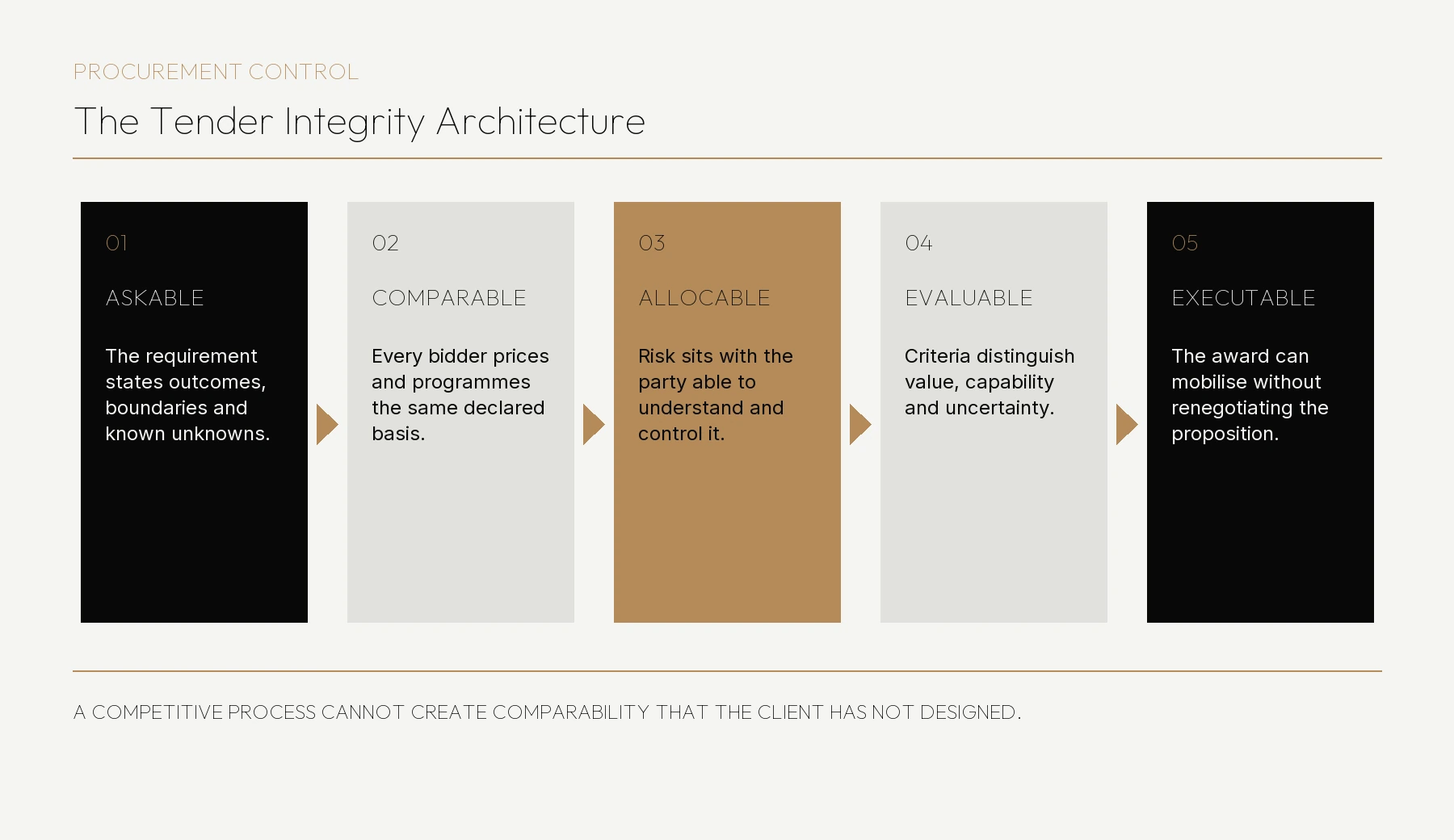
A tender creates value only when bidders are pricing the same requirement, accepting a visible risk basis and responding to a consistent evaluation logic. Without that comparability, the lowest price may represent a different project rather than a better offer.
This paper explains how premium-sector clients can establish procurement integrity before market engagement: define the requirement, separate price from exclusions and assumptions, govern substitutions, test mobilisation and protect the sensory and technical qualities through which customers recognise the brand.
KEY TAKEAWAYS
- 01Competition cannot correct an unclear or internally inconsistent tender basis.
- 02Price comparison is meaningful only after scope, assumptions, exclusions and risk are normalised.
- 03Material substitutions must be assessed against performance and customer perception, not appearance alone.
- 04Tender award should create an executable basis for mobilisation, not merely identify a preferred bidder.
Why the next commitment - not the volume of documentation - should set the evidence threshold
A FAMILIAR SITUATION
The room is ready. The decision may not be.
The leadership meeting begins with a reassuring pattern. The concept has been presented before. The cost plan has a headline number. The programme still reaches the intended opening date. Every function has attended a review, and no one is asking to stop.
Then a practical question appears. Has the landlord confirmed the required capacity? The answer is almost. Has the service model been tested at peak load? Not yet, but operations is comfortable. Has the critical finish been produced at scale? The sample is due next week. None of these answers sounds fatal. Together, however, they describe a project about to make an irreversible commitment on the basis of several unconnected beliefs.
This is a common point of danger in premium projects. Organisational confidence rises because work has been completed, not because the decisive uncertainties have been reduced. The project looks mature. Its evidence may still be young.
Readiness always has a denominator
A project is never simply ready. It is ready for something: a reversible customer test, a design freeze, a lease, a tender, a manufacturing slot, a capital release or a portfolio rollout. Each step changes the cost of being wrong and therefore changes the evidence that leadership should require.
A prototype can be responsible under high uncertainty because its exposure is deliberately limited and its purpose is to learn. The same uncertainty may be irresponsible before a long lease or a bespoke production commitment. Readiness is therefore relational. It connects what the organisation knows to what it is about to make difficult to reverse.
This distinction matters because conventional readiness reviews tend to count completion: drawings issued, approvals obtained, meetings held, budgets submitted. Those signals describe process activity. They do not establish that the evidence is strong enough for the next commitment.
Public appraisal systems in the UK, EU, US and Australia use different language, but share a useful discipline: major commitments should rest on an explicit objective, credible alternatives, stated assumptions, a delivery case and a visible account of risk. The lesson is not to import public-sector bureaucracy into retail or hospitality. It is to resist the idea that momentum is itself evidence. [D02-D05]
What leadership needs to know
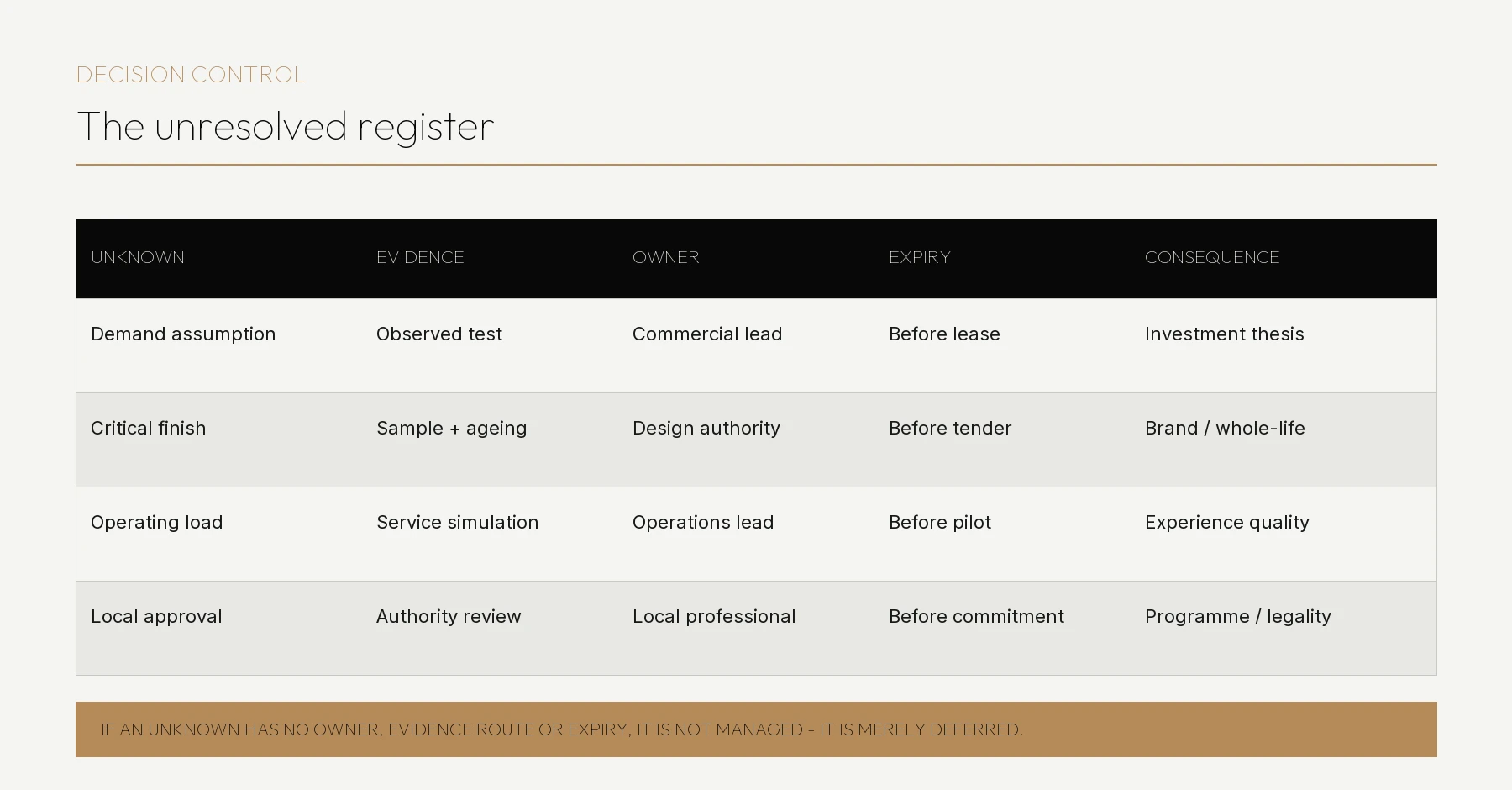
Six conditions make a decision genuinely ready. First, the intended outcome must be clearer than the preferred expression. The team should be able to say what must become true for customers, the business and the operation - even if the current design changes.
Second, the preferred route must have survived contact with alternatives. A base case, a smaller intervention or a different sequence can reveal whether the proposal is valuable or merely familiar. Third, the assumptions capable of changing the answer must be connected to evidence: observed, tested, costed or professionally verified.
Fourth, the economics must be visible as mechanisms and ranges. A single capital number conceals the variables that create downside: demand, productivity, maintenance, duty, lead time, replacement or delay. Fifth, authority must be explicit. The person who recommends, the person who decides, the person who carries delivery and the person who can challenge a technical assumption are not always the same.
Finally, the decision must preserve proportionate control. Conditions, pilots, breakpoints, review triggers and credible exit routes are not signs of weak conviction. They are how responsible leaders act under uncertainty. ISO 31000 and the Saudi EXPRO framework both support this integration of risk, ownership and decision control rather than treating risk as a separate register. [D06-D07]
FROM ENDORIENCE PRACTICE
The material that could not be made
In one anonymised project, every visible part of the package appeared ready for manufacture. A special material had been specified for several shaped elements, and the programme waited weeks for it to arrive. The material was exceptionally expensive in relation to the package, but its appearance seemed to justify the commitment.
When fabrication began, the team discovered that no one had verified whether the material could be formed to the required angle. It was not simply difficult to bend. No available process could produce the geometry without failure. The project had paid for the material and absorbed the lead time before testing the assumption on which the design depended.
The affected elements had to be redesigned and manufactured again. The loss came from treating material selection as evidence of manufacturability. A small forming trial would have changed the decision before cost and time became irreversible.
A better release decision
Binary go/no-go language encourages teams to defend momentum. Leadership has more useful choices. It can commit where evidence is sufficient; commit conditionally where a small number of named conditions must close; test where a bounded action will resolve an important assumption; redesign where the objective remains valid but exposure is concentrated; or decline where value no longer justifies commitment.
These are not softer versions of a decision. They are more precise. They allow ambition to survive without forcing the organisation to pretend that every assumption has the same confidence.
The strongest use of readiness is early and repeated. Before a lease, the denominator may be location economics and statutory viability. Before tender, it may be scope comparability and interface definition. Before manufacture, it may be approved samples, tolerances and supply continuity. Before rollout, it may be first-of-type evidence and local operating readiness. The question evolves because the commitment evolves.
The executive implication
Decision readiness is not a bureaucratic layer before action. It protects action from false confidence. It also prevents the opposite error: waiting for certainty that no complex project can provide.
Ready does not mean finished. It means the organisation has earned the right to make the next commitment.
Evidence notes
EVIDENCE USED IN THIS PUBLICATION
D01 ENDORIENCE (2026). ENDORIENCE consulting products. Source
D02 HM Treasury (2026). The Green Book 2026. Source
D03 U.S. Government Accountability Office (2009). Cost Estimating and Assessment Guide. Source
D04 European Investment Bank (Current). Project cycle and project appraisal. Source
D05 Infrastructure Australia (2021). Assessment Framework Stage 3: Developing a Business Case. Source
D06 Saudi EXPRO (Current). National Manual for Project Management. Source
D07 International Organization for Standardization (2018 / confirmed 2023). ISO 31000:2018 Risk management - Guidelines. Source
D08 UK Cabinet Office (2022). The Construction Playbook. Source
D09 Royal Institute of British Architects (2020). RIBA Plan of Work 2020. Source