EXECUTIVE SUMMARY
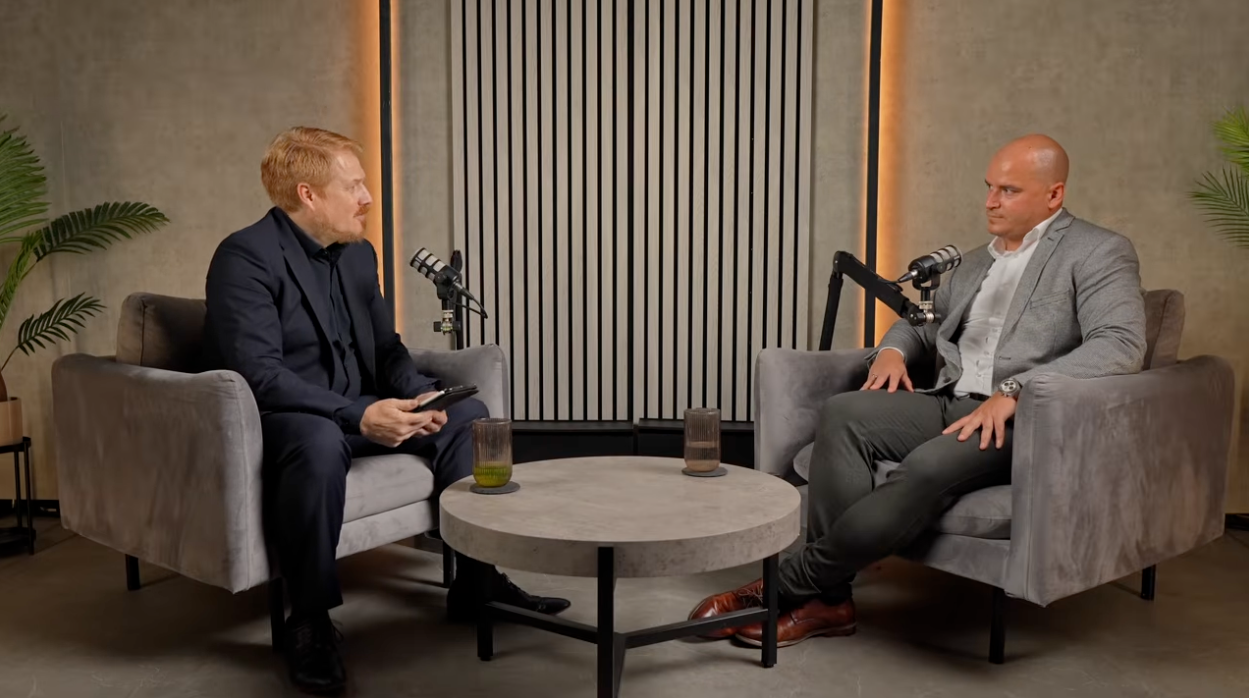
In the first episode of The Decision Space, host Hans Petersen sits down with Gergő Nidermayer, who has spent close to twenty years designing and building premium retail and hospitality environments. They trace how the space stopped being a neutral backdrop and became part of the product itself, why premium now competes on understanding the person rather than on price, and where the original idea quietly leaks away between the design studio, the factory and the room a customer finally walks into.
KEY TAKEAWAYS
- 01Space is never neutral. Every environment influences behaviour, perception and ultimately business performance.
- 02Design is a business decision. The question is not simply how a space looks, but what it is designed to achieve.
- 03The real value starts before design. Better spaces begin with better decisions about purpose, priorities and outcomes.
TRANSCRIPT (FULL)
HANS PETERSEN
So there are no more neutral spaces.
The space works for you, or it doesn't work at all.
Welcome to The Decision Space.
This is a series where we're going to be talking about the quiet revolution in the spaces where we shop, where we make decisions and where we spend our time.
My name is Hans Petersen, and today my guest is somebody who's been designing and building these kinds of spaces for the better part of 20 years.
Gergő Nidermayer.
Welcome, Gergő.
GERGŐ NIDERMAYER
Thanks. Glad to be here.
HANS
I'm glad to have you here.
Most people think that a shop is a shop. You go in, you browse, you pick out a product, you pay for it, you take it home, and that's that.
But I think what we're talking about here is something more detailed: the process itself and how you can influence it.
GERGŐ
A shop used to be simply a space to hold the product.
Now the shop—or the space—is part of the product itself.
Think about entering a new kind of store. You experience the whole journey from the moment you step inside until the moment you leave.
HANS
What has changed recently that has made this a much more important aspect of designing a shopping experience?
GERGŐ
Mainly, society has changed.
It has changed because of the internet. It has changed because of what has happened over the past several years.
The market is much more divided now.
Broadly speaking, we can identify two categories: mass market and premium.
If we're talking about the mass category, businesses need to compete primarily on price.
But if we're talking about premium, they need to compete through the experience they can give their customers—not simply through the product itself.
They need to compete through the shop as well.
People have stopped buying only objects.
They're buying a feeling. They're buying the brand. They're buying an experience.
HANS
I'm trying to put that into the context of my own shopping experiences.
A couple of years ago, I was in Morocco. I had seen handmade carpets in various shops.
But in one particular shop, I had the full experience.
They walked me in, gave me tea, we sat down and had a conversation.
In the end, that experience—the connection I had with the shop owner, with the city and with the people I was travelling with—became part of the memory of buying what eventually became a rather expensive carpet.
Is that similar to what you're trying to help create for your customers?
GERGŐ
Yes, absolutely.
Mass products and mass shopping compete primarily on price.
When we move into premium, the competition is about understanding the person, understanding the buyer and understanding the customer of the brand.
That's a completely different game.
And I think it happens quite organically.
If you don't feel comfortable in a particular space, perhaps it isn't your space.
If you do feel comfortable, then that can become your brand, your space and ultimately your product.
HANS
Where is the line between knowing your customer and shutting people out?
GERGŐ
There isn't an exact line.
I don't think the objective should ever be to actively exclude somebody.
The point is that if you're elevating your brand and your space, and you understand your customers, then you need to focus on them.
That saves time and, ultimately, cost.
HANS
So you're not actively trying to exclude people. You're focusing on the people who are most interested in or most relevant to the product you're offering.
GERGŐ
Exactly. Never try to exclude.
Quite the opposite, actually.
Even if someone feels that a particular space or journey isn't intended for them, that can still reinforce the positioning of the brand.
HANS
Before we get further into who these spaces are for, let's take a step back.
For years—practically since the dot-com boom—I've been hearing that retail is dead and that everything is moving online.
Why isn't that true? Or is it?
GERGŐ
I definitely don't think it's true.
Digital is one thing.
But if you want to buy a real premium product—or experience what it means to buy one—you need a physical presence.
You need to experience the smell. You need to feel the materials. You need to touch what you want to buy.
You need to experience the entire atmosphere the brand creates around you.
That's why investment in premium physical spaces has increased.
Premium brands need to invest more in their stores and create much stronger experiences for their customers.
HANS
So it isn't simply that the space has become part of the product.
It sounds like the space has become part of the overall strategy.
GERGŐ
It has to be part of the strategy.
Without the right space, the right feeling and the right customer journey, you cannot create the right experience for the customer.
HANS
With brands investing more in their spaces, I assume mistakes become significantly more consequential.
GERGŐ
Absolutely.
When retail was essentially white walls, shelving and product storage, a small mistake wasn't necessarily a major issue.
But if you think about today's highly exclusive environments, creating the wrong space can become a significant mistake—not only for the product, but for the brand itself.
Imagine creating a space with the wrong colours or the wrong customer experience.
The customer may never want to return.
That creates a long-term effect.
HANS
So you're not simply losing the sale on that particular day.
You may be losing sales far into the future.
GERGŐ
Exactly.
The effect can be very long-term, and potentially very damaging for the brand.
HANS
One thing I've noticed in premium retail is that brands are becoming increasingly ambitious with their physical environments.
There is significant investment, bigger ideas and increasingly challenging concepts.
What effect is that having on the people responsible for actually creating these experiences?
GERGŐ
That's absolutely true.
Brands now have a much greater presence across different channels, and customers can access them much more easily.
As a result, brands want bigger ideas and more ambitious projects to demonstrate that they are leading their markets.
That creates a significant challenge for the people responsible for making those spaces real.
And that's something companies like ours need to be able to manage.
HANS
Can you describe the process of creating these spaces?
What goes into realising something this ambitious, and what can go wrong?
GERGŐ
We're much more global than before.
A space may be designed in one part of the world, manufactured in another and installed somewhere else entirely.
It can therefore be very difficult to preserve the same idea throughout the entire process.
And sometimes that process is very long.
From the original concept to final installation, it can easily take six months or even a year.
HANS
So imagine an agency in New York designing a space, somebody in another country manufacturing it, and then everything being delivered to a shop in Berlin.
Is that close to the reality?
GERGŐ
Yes, that's essentially what we're talking about.
The exact locations obviously vary, but the principle is correct.
Design happens in one place, manufacturing somewhere else, and installation at the final location.
Just imagine how many languages, misunderstandings and potential mistakes can enter that process.
HANS
With that many people involved, there are clearly many opportunities for miscommunication to take things in the wrong direction.
GERGŐ
Exactly.
And that's one of the biggest risks.
You can begin with a very strong design and a very strong concept, but if the final result contains seemingly small mistakes in real life or during installation, they can undermine the entire customer journey and the whole experience.
Usually, on the brand or customer side, there may only be one or two people responsible for trying to make the whole concept real.
But brands naturally focus primarily on their products.
They aren't necessarily experts in the technical reality of creating and installing the space itself.
That's one of the biggest gaps.
And it's where you can lose much more than money.
You can lose time. You can lose the identity of the project. You can lose the original concept you were trying to create.
You shouldn't give all of that responsibility to somebody who doesn't have the relevant experience.
HANS
Can you give me a practical example?
Perhaps a situation that shows the different components involved in realising a space and what can happen when one of them goes wrong.
GERGŐ
Let's take a simple example.
Imagine a very good design company creating a concept for a jewellery brand selling diamonds.
They design a curved glass display.
They know that curved glass exists, but they don't necessarily know exactly how it needs to be manufactured, which type of glass should be used or how it needs to be illuminated.
So you can end up with a beautiful product behind a display case that looks good as an object—but you cannot properly see the product inside because the lighting or the glass specification is wrong.
Instead of seeing the diamond clearly, you might see unwanted colour distortion or reflections.
That can become a major mistake.
HANS
So the person responsible for getting everything right needs to understand all of those disciplines.
GERGŐ
Yes, and that's an enormous knowledge base.
You need to understand the design.
You need to understand the product.
You need to understand the materials being used.
You need to understand the lighting.
And beyond all of that, you need to understand the customer and how they need to experience the product.
HANS
So the real goal is that what gets imagined and what actually gets delivered are the same thing.
There shouldn't be a gap between them.
GERGŐ
Yes.
And ultimately, what was imagined and what gets delivered also need to meet the expectations of the customer who will eventually buy the product.
HANS
The main thing I'm taking from this conversation is that the spaces where we shop aren't neutral anymore.
The space itself is part of the whole process.
GERGŐ
Exactly.
There are no more neutral spaces.
The space works for you, or it doesn't work at all.
HANS
Next time, we're going to explore that gap we discussed—the gap between what gets imagined and what gets delivered, and why there often isn't anyone specifically responsible for guarding that space.
Thanks for watching.