EXECUTIVE SUMMARY
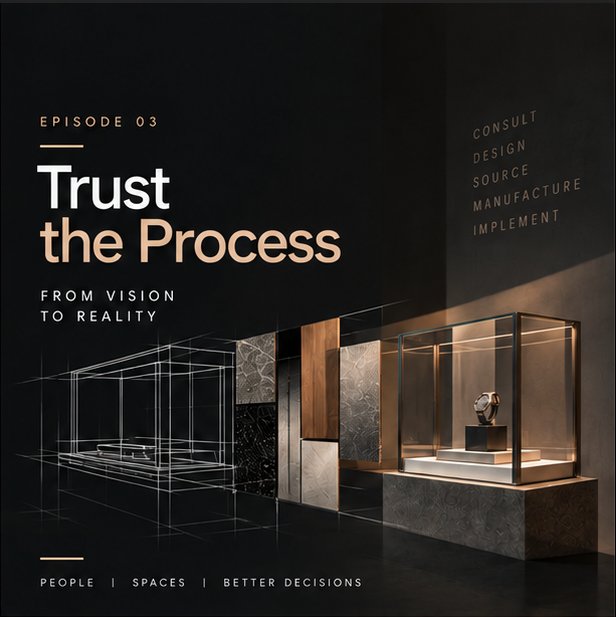
A successful premium environment is not created at the moment manufacturing begins.
It starts considerably earlier—with understanding the brand, the product, the target customer, the market and the commercial purpose of the space. This makes the implementation process fundamentally different from conventional procurement, where a supplier simply receives drawings and produces what has been specified.
The strongest process connects strategy, design and implementation. Early-stage analysis identifies the target audience and market context. Concept development translates those insights into spatial directions. Material selection, technical design, sampling and prototyping then progressively remove uncertainty before manufacturing begins.
This is particularly important in premium environments because apparently small technical decisions can materially affect the final customer experience. Material authenticity, durability, detailing, maintainability and installation quality all influence whether the original design intent survives implementation.
The same principle applies to cost. Value engineering should not simply mean replacing specifications with cheaper alternatives. Done correctly, it protects the elements the customer actually experiences while finding more intelligent technical solutions behind them.
The strategic implication is that manufacturing represents only one stage of the value chain. The greater value lies in protecting the original intention throughout the journey from concept to reality.
KEY TAKEAWAYS
- 01Implementation begins before manufacturing.
- 02Premium execution is a progressive risk-reduction process.
- 03Value engineering should protect perceived quality.
- 04The real deliverable is not furniture. It is continuity of intent.
TRANSCRIPT (FULL)
KEVIN
Welcome back to ENDORIENCE.
Today we’re doing something a little different. I’m putting myself in the shoes of a client.
Gergő, imagine I’m a European luxury watchmaker and I need a premium custom retail environment. I’ve heard great things about TRUSTED, but I’m not yet convinced.
Walk me through exactly what your process looks like.
When I first reach out, what happens?
GERGŐ
First, we need to understand each other.
We need to understand what you want to achieve with your brand, what you want to achieve with your products and, most importantly, who your exact target audience is.
That is the starting point.
KEVIN
So you aren’t simply there to build something. You need to understand the wider design philosophy, strategic direction and target demographics.
GERGŐ
Exactly.
If we want to create a successful retail store or point of sale, we need to understand your clients and customers.
And nobody should understand them better than the brand itself.
KEVIN
What else do you need to know?
GERGŐ
We need to understand the exact location and market.
Then we study the brand: the materials, components, colours and other elements that fit both the brand and its customers.
KEVIN
When do I start seeing design ideas?
GERGŐ
Once we have enough information, we research the target audience.
Usually within one or two weeks we can begin developing sketches, basic concepts and mood boards.
Then we discuss those directions together.
KEVIN
So you can perform market analysis yourselves?
GERGŐ
Yes, and we prefer to be involved.
If we simply receive ideas from a third party, we cannot always be certain that those ideas are focused on the right priorities.
KEVIN
As a luxury watchmaker, my customers expect extremely high quality.
How do you make sure the design meets that expectation?
GERGŐ
Location is critical.
Once we know where the store will be, we can understand which materials and visual languages are perceived as premium or luxury in that particular market.
Then we develop the concept accordingly.
KEVIN
Let’s say I’m opening a luxury watch store in Vienna.
How would you approach it?
GERGŐ
Vienna is in Central Europe, close to Switzerland and Germany, and it has a relatively conservative luxury culture.
The design therefore probably shouldn’t be unnecessarily aggressive or colourful.
If you study established premium streets in Vienna, you will see restrained palettes and very controlled environments.
Materials can evolve, but the fundamental language remains relatively consistent.
KEVIN
Do I receive one design option?
GERGŐ
No. We normally start with at least three concepts.
Then you can select one or two directions and we develop them further.
KEVIN
How do you integrate client feedback?
GERGŐ
We have an experienced internal design team.
We develop revised mood boards and then increasingly detailed concepts for particular parts of the store.
That allows the client to understand not only how the environment will look, but how it should feel to the customer.
KEVIN
What happens when a client has an idea that is extremely difficult or expensive to execute?
GERGŐ
If we identify red flags, we raise them immediately.
We need to identify the weak points of a concept early. Otherwise those issues become endless discussions later in the project.
Budget is another critical consideration.
There are often technical ways to reduce cost while maintaining the customer-facing quality and material experience.
KEVIN
So that is where consultation and experience become important.
GERGŐ
Exactly.
It is fundamentally a consultation process.
KEVIN
Where do you source materials?
GERGŐ
There isn’t one typical source.
We source globally.
High-quality stone may come from Italy. Wood may come from Germany, Canada, Sweden, Hungary or another appropriate region.
Some specialised acrylics, textiles and other materials may only be available from one or two specific suppliers.
KEVIN
Once the design is complete, how long does the quotation take?
GERGŐ
If we have developed the design ourselves, usually no more than around ten days for the first stage.
If the design comes from an external designer, we ideally want to speak with them.
A drawing can show many things, but it doesn’t always communicate the priorities and intention behind the concept.
As manufacturers, we need to understand why the concept is the way it is.
Normally, that process is still around ten to fifteen days.
KEVIN
What happens if I receive the quotation and tell you I can have it manufactured in China for less?
GERGŐ
That is obviously the client’s decision.
But in many cases you won’t receive the same combination of quality and service.
European proximity allows us to support the project throughout the process, work closely with the material sources and remain involved through installation.
China is exceptionally strong in mass production.
It can also produce very high-quality work, but once you require the same specialist materials, labour, detailing and service level, the price difference can become much smaller.
KEVIN
What about Turkey?
GERGŐ
Turkey has developed significantly and can produce very competitive high-quality work.
The difference is increasingly not simply the finished product.
It is the process, service, compliance environment and implementation support surrounding it.
KEVIN
So implementation is really the differentiator.
GERGŐ
Exactly.
The crucial question is how the design becomes real furniture and ultimately a real retail environment.
KEVIN
I’ve accepted your offer. What happens next?
GERGŐ
After concept approval and commercial agreement, we move into technical design.
This is a deep dive into how the furniture actually works.
You see exactly how it will be constructed, how it functions and how it will be used.
That is particularly important in luxury retail because these environments may be used for many years.
KEVIN
And they experience much more intensive use than residential furniture.
GERGŐ
Exactly.
A retail environment can have anywhere from tens to potentially hundreds or more customer interactions in a day.
It is not comparable to furniture in a private home.
KEVIN
Can the client inspect materials or prototypes before manufacturing?
GERGŐ
Absolutely.
During technical development we create material samples.
The client receives the relevant surfaces, colours and materials, often as a complete sample set.
At that point there is still time to change something.
On larger or more complex projects, we may also manufacture full prototypes.
That gives another opportunity to validate the solution before serial or final manufacturing begins.
KEVIN
How do you make sure everything arrives and is installed on schedule?
GERGŐ
Through very tight project management.
Once a project starts, we continuously monitor its progress. We need visibility almost day by day.
KEVIN
Why should I choose a company of your size rather than one of the largest international suppliers?
GERGŐ
Our size can actually be an advantage.
We can focus on customers individually.
We can guide the client through the entire process.
With very large suppliers, a client may ultimately interact with only one or two project managers who are simultaneously responsible for many other projects.
We approach that differently.
KEVIN
What is the one thing a new client should remember about TRUSTED?
GERGŐ
That manufacturing and installing the retail environment is only one part of the project.
A large part of the value is created before manufacturing begins.
It comes from consultation and from the know-how we can bring into the process.
KEVIN
That is ultimately the value you bring to the table.
Thank you very much, Gergő.
GERGŐ
Thank you.